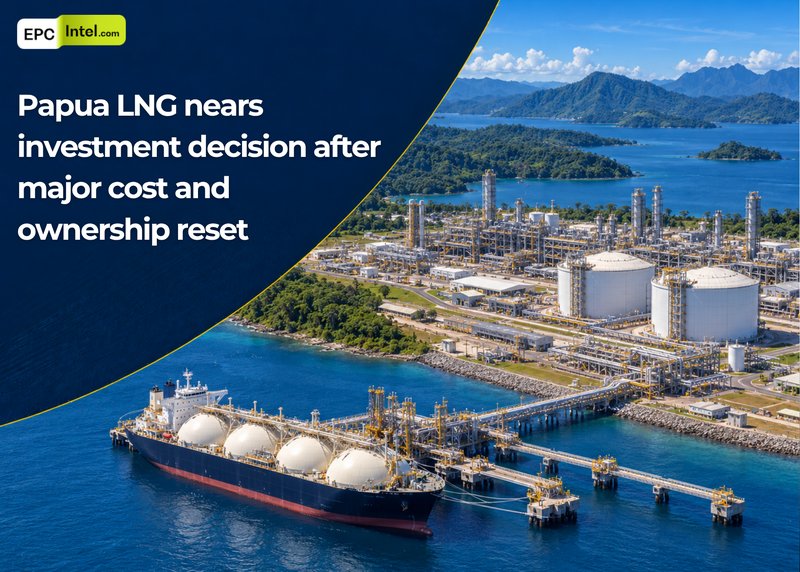
Papua LNG has completed EPC tendering and reduced its estimated capital expenditure to approximately US$14 billion, clearing two important obstacles on its path toward a final investment decision. The transfer of operatorship from TotalEnergies to ExxonMobil also signals a deeper integration with the existing PNG LNG operation.
Papua LNG has entered a decisive pre-FID phase following a broad restructuring of its development concept, procurement strategy, ownership and commercial arrangements.
The project’s EPC tendering process has been completed, with contract award recommendations now ready to be submitted to the co-venturers for approval. No contractors or individual packages have yet been confirmed, meaning the development has reached the recommended-award stage rather than the formal EPC award stage.
Nevertheless, the completion of tendering gives the partners a clearer view of project costs, contractor availability and execution risks ahead of the final investment decision.
EPC rebidding delivers major savings
One of the most significant developments is the reduction of estimated project capital expenditure to approximately US$14 billion.
TotalEnergies said that project design optimisation and the rebidding of EPC packages have generated close to US$4 billion in savings since 2024. The procurement process was reopened to a larger group of Asian EPC contractors, increasing competition and allowing the project partners to reassess construction costs.
The revised development concept also includes an alternative upstream condensate scheme designed to use infrastructure and operating synergies with the existing PNG LNG project.
A reduction of this scale materially changes the project’s investment profile. It lowers the capital that must be financed, improves resilience against weaker LNG price cycles and could strengthen the partners’ ability to move toward FID.
For EPC contractors, however, the savings also point to a highly competitive bidding environment. The selected companies will be expected to deliver a complex, integrated LNG development under tighter cost assumptions than those considered during earlier engineering phases.
ExxonMobil operatorship changes the execution model
The decision to transfer operatorship from TotalEnergies to ExxonMobil is more than an ownership adjustment. It represents a shift toward an integrated execution and operating model built around ExxonMobil’s existing presence in Papua New Guinea.
ExxonMobil already operates PNG LNG, which includes upstream production facilities, pipelines and an LNG plant near Port Moresby. Placing Papua LNG under the same operator could allow the project to use established technical capabilities, operating systems, supply chains and local infrastructure.
These synergies could be particularly valuable during construction, commissioning and long-term operations. They may also reduce duplication between the two LNG developments and simplify the management of shared facilities and interfaces.
TotalEnergies and ExxonMobil will jointly manage the transition to maintain continuity of project activities and existing commitments to the Papua New Guinea government and other stakeholders.
Following completion of the proposed ownership changes and the State’s back-in rights, ExxonMobil will hold a 34.1% interest and serve as operator. TotalEnergies will retain 20%, Santos 21% and ENEOS Xplora 2.4%, while Kumul Petroleum Holdings Limited and MRDC will hold a combined 22.5%.
TotalEnergies will sell a 9.1% interest to the other project partners in proportion to their existing holdings. Despite reducing its equity participation, the company will maintain its LNG offtake share, allowing it to preserve access to the project’s production while lowering its exposure to development capital.
Commercial structure supports financing
The partners have also finalised an amended gas agreement with the government of Papua New Guinea. The original agreement, signed in 2019, has been updated to reflect the revised development budget and project optimisation measures.
According to TotalEnergies, the amended terms are intended to support robust project economics, including during periods of lower LNG prices, while preserving the State’s long-term fiscal interests.
In parallel, TotalEnergies and Papua New Guinea state-related entities represented by Kumul Petroleum have established an LNG marketing joint venture. The venture will jointly commercialise 2.4 million tonnes per annum from Papua LNG’s planned production of 5.6 Mtpa.
TotalEnergies has signed a separate heads of agreement to purchase 1.5 Mtpa from the marketing venture for its global LNG portfolio.
These arrangements provide greater visibility over future LNG sales and could help support project financing. They also give Papua New Guinea’s state entities a more direct role in marketing the country’s LNG production.
What comes next?
Papua LNG is designed to develop the Elk and Antelope gas fields in Gulf Province. Its scope includes upstream gas production and processing facilities, a pipeline connecting the fields with the liquefaction site, and LNG infrastructure near Port Moresby.
The latest announcement resolves several important pre-FID issues: the EPC packages have been competitively tendered, estimated capital costs have been lowered, operatorship has been clarified, the gas agreement has been updated and marketing arrangements are taking shape.
The next critical steps will be approval and formal award of the EPC packages, completion of the operatorship and ownership transactions, confirmation of financing arrangements and the final investment decision.
Papua LNG has therefore moved substantially closer to execution, but it has not yet crossed the line into construction. Until the co-venturers approve the recommendations and the contracts are formally awarded, the identities and scopes of the selected EPC contractors remain unconfirmed.
If FID proceeds, the project would reinforce Papua New Guinea’s position as an LNG exporter while creating a major new opportunity for Asian engineering, construction and equipment suppliers. More importantly, it would demonstrate how an LNG megaproject can be reshaped through rebidding, design simplification and integration with existing infrastructure to improve its competitiveness before investment approval.