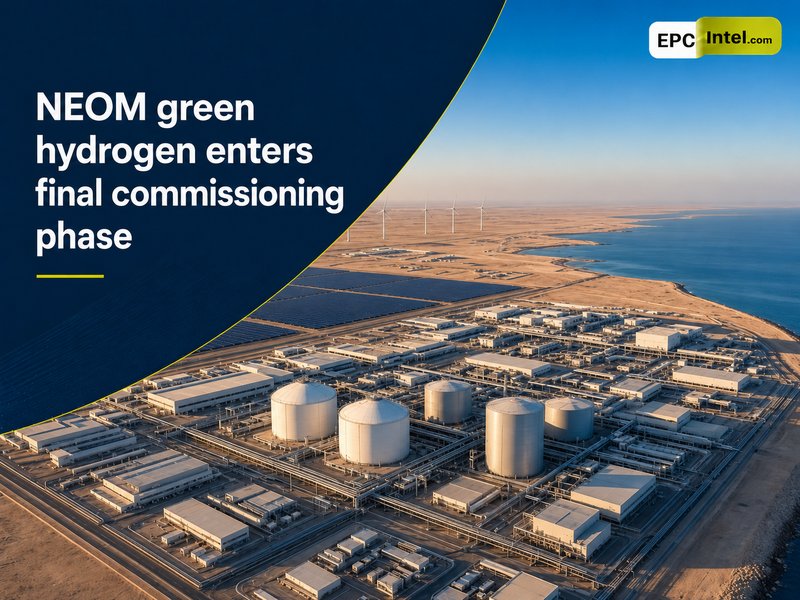
Saudi Arabia’s $8.4 billion NEOM Green Hydrogen Project has entered its most important phase yet, with construction approaching completion and commissioning underway following the energization of the facility.
Reports claiming that construction is fully complete appear slightly premature. Air Products currently describes the development as being in “final completion,” while commissioning has started across the renewable power and production systems.
Still, this is no longer another hydrogen project represented mainly by renderings and ambitious production targets. Thousands of pieces of equipment have been installed across the wind farm, solar park, transmission network, hydrogen plant, ammonia facilities and export infrastructure.
For the EPC market, NEOM is becoming the project against which the next generation of green hydrogen developments will be measured.
An $8.4 billion integrated development
Located at Oxagon in northwest Saudi Arabia, the project is being developed by NEOM Green Hydrogen Company, an equal joint venture between NEOM, ACWA Power and Air Products.
The partners reached financial close in 2023 at a total investment value of $8.4 billion, including $6.1 billion of non-recourse financing provided by 23 financial institutions.
Air Products is the main EPC contractor and system integrator under agreements valued at approximately $6.7 billion. It is responsible for coordinating the complete renewable power-to-ammonia chain and will purchase all the green ammonia produced under an exclusive 30-year offtake agreement.
The project combines approximately 4 GW of renewable generation with more than 2 GW of electrolysis capacity. Once operational, it is expected to produce up to 600 tonnes of green hydrogen per day, which will be converted into approximately 1.2 million tonnes of green ammonia annually.
Contractors behind the project
While Air Products controls the main EPC scope, delivery has involved several of the energy industry’s largest engineering, construction and technology companies.
Larsen & Toubro secured the largest publicly disclosed subcontract package. Its approximately $2.78 billion scope covers the renewable generation, battery storage and electrical grid infrastructure required to supply the hydrogen plant.
L&T’s work includes the construction of a 2.2 GW solar photovoltaic plant, the 1.67 GW wind generation system and a dedicated 400 kV transmission network. The package also involves substations, overhead transmission lines and associated electrical infrastructure connecting the renewable assets with the production complex.
The electrolyser package was awarded to thyssenkrupp nucera. The company is supplying more than 2 GW of alkaline water electrolysis capacity using large-scale standardized modules. This is one of the largest electrolyser orders ever placed and represents the technological centre of the hydrogen production facility.
Envision Energy was selected by Air Products to supply 1.67 GW of wind turbines. Its scope covers 257 units based on the company’s 6.5 MW turbine platform. The first major turbine components arrived at the project site in 2023, followed by installation across the wind garden.
Topsoe is providing the ammonia technology that will convert the renewable hydrogen into approximately 3,500 tonnes per day of green ammonia. Converting hydrogen into ammonia allows the product to be stored and transported using established marine and terminal infrastructure.
Baker Hughes is another important technology supplier, providing advanced compression equipment for the hydrogen facilities. Compressors are a critical part of the process, increasing hydrogen pressure for downstream treatment and conversion into ammonia.
Together, these companies form the core contractor group behind the project: Air Products as EPC integrator, L&T for renewable power and transmission, thyssenkrupp nucera for electrolysis, Envision Energy for wind turbines, Topsoe for ammonia technology and Baker Hughes for hydrogen compression.
Where the money is being spent
The disclosed package values provide a clearer view of the project’s capital structure.
Approximately $2.78 billion has been allocated to L&T’s renewable power, storage and grid infrastructure scope. The remaining portion of the $6.7 billion EPC value covers the hydrogen plant, electrolysers, ammonia production facilities, compression systems, utilities, storage and export infrastructure.
Based on typical expenditure structures, the electrolyser and hydrogen balance-of-plant scope could account for approximately $1.5 billion to $2 billion. The ammonia synthesis, refrigeration and storage systems could represent another $1 billion to $1.4 billion.
Export facilities, water systems, utilities, buildings and supporting infrastructure may account for a further $700 million to $1 billion. These figures are EPCIntel estimates, as individual values for the thyssenkrupp nucera, Envision Energy, Topsoe and Baker Hughes packages have not been disclosed.
Commissioning is the real test
The project must now demonstrate that its wind, solar, grid, electrolysis and ammonia systems can operate reliably as one integrated facility.
Commissioning will involve energizing and testing individual systems before progressively introducing water, hydrogen, nitrogen and ammonia into the production chain. The intermittent nature of wind and solar generation adds another layer of operational complexity.
First green ammonia availability is expected in 2027. If the commissioning programme succeeds, NEOM will provide more than a new source of low-carbon fuel. It will establish an engineering and commercial template for hydrogen developments across the Middle East, Africa, Australia and other renewable-rich markets.
Saudi Arabia has not quite completed the journey at Oxagon, but the world’s largest green hydrogen project is now close to becoming an operating industrial asset.