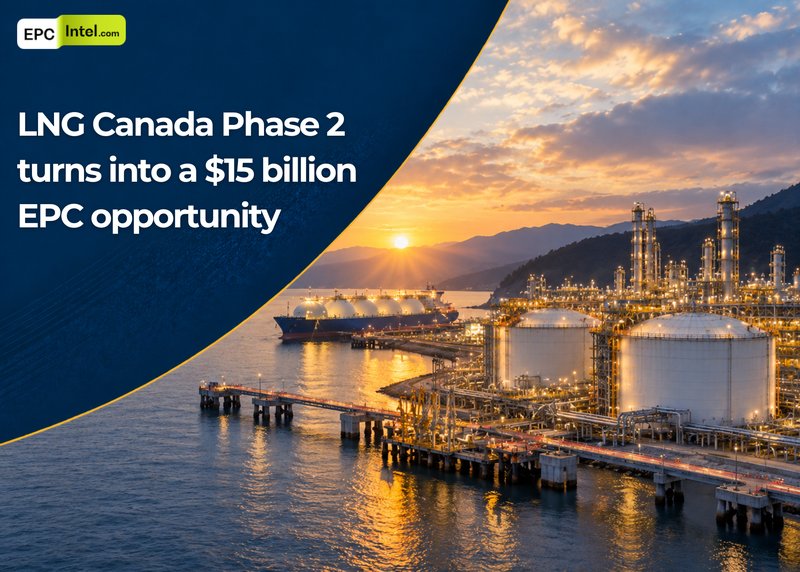
LNG Canada has pulled the trigger on Phase 2, and for the EPC supply chain the important number is not just the extra LNG capacity. It is the sheer amount of procurement now moving into execution.
Following final investment decision, the JGC Fluor BC LNG II joint venture has received notice to proceed for engineering, procurement, fabrication, construction and commissioning of the expansion at Kitimat, British Columbia. Fluor will book US$7.5 billion as its share of the contract.
The execution JV is owned 50:50 by Fluor Canada and JGC Constructors (No2) BC, making this one of the largest LNG EPC awards currently entering execution.
What is being built
Phase 2 effectively doubles LNG Canada.
Two additional liquefaction trains will be constructed alongside the existing facility, increasing total production capacity from approximately 14 million tonnes per annum to 28 mtpa. The development also includes another LNG storage tank, condensate storage, an additional loading berth and expansion of process and utility systems.
That existing infrastructure matters.
Fluor and JGC already delivered Phase 1, including two LNG trains, storage facilities, utilities, marine infrastructure and other supporting systems. LNG production started in June 2025 and final handover followed in October.
Rather than mobilising a completely new EPC organization, LNG Canada is effectively extending an established engineering, procurement and construction machine.
For suppliers, that should make the Phase 1 vendor ecosystem particularly important.
The EPC opportunity
Fluor has disclosed that its share of the Phase 2 contract is US$7.5 billion. The company describes the overall award as a multibillion-dollar contract but has not disclosed its full value. Given the 50:50 structure of JGC Fluor BC LNG II, a figure around US$15 billion provides a reasonable indication of the scale associated with the JV award, although it should not be treated as a formally disclosed contract value.
Based on EPCIntel.com‘s database of comparable LNG developments, a project of this scale could typically direct approximately:
Liquefaction and process equipment: 25-30%
Potential spend of roughly US$3.8-4.5 billion across compressors, turbines, heat exchangers, refrigeration systems, cryogenic equipment, pressure vessels and associated packages.
Bulk materials and piping: 15-20%
Around US$2.3-3.0 billion could flow into piping, valves, structural steel, insulation and other bulk materials.
Civil and construction: 15-20%
Approximately US$2.3-3.0 billion covering foundations, buildings, site works, construction services and installation.
Electrical, instrumentation and control: 8-12%
Potentially US$1.2-1.8 billion for electrical systems, substations, switchgear, cabling, instrumentation, automation and control systems.
Storage, marine and utilities: 10-15%
Potentially US$1.5-2.3 billion across LNG storage, condensate facilities, utilities, loading infrastructure and associated balance-of-plant packages.
These are indicative EPCIntel benchmarks rather than announced procurement values, but they show why the award matters well beyond Fluor and JGC.
The pipeline opportunity gets bigger too
There is another layer to the contracting story.
Phase 2 requires more feed gas, which means expansion of the Coastal GasLink system connecting western Canadian gas resources with Kitimat.
LNG Canada says it has entered commercial agreements to act as execution manager for the expansion, which will increase pipeline capacity through construction of five new compressor stations. The existing pipeline extends approximately 670 kilometres.
That creates a parallel procurement market around gas compression packages, turbines or drivers, pressure vessels, piping, electrical systems, instrumentation, modular buildings and construction services.
In other words, suppliers should not look at Phase 2 as one LNG EPC contract.
It is an LNG plant expansion plus a major upstream transportation and compression program.
Where suppliers should be looking
The obvious route into the main plant is the JGC Fluor BC LNG II procurement organization. The less obvious opportunity is the established Phase 1 supply chain.
The same contractors delivered Phase 1, and the new trains are being constructed beside infrastructure specifically designed to accommodate expansion. Fluor says the Phase 2 award builds directly on the JV’s previous delivery experience.
That gives incumbent fabricators, equipment manufacturers and subcontractors an advantage, but a project of this size will still require substantial additional capacity.
With two LNG trains, new storage, expanded marine facilities, utilities and five pipeline compressor stations moving forward, LNG Canada Phase 2 is no longer a future LNG opportunity.
The procurement cycle has started.