The FEED award matters more than its immediate value
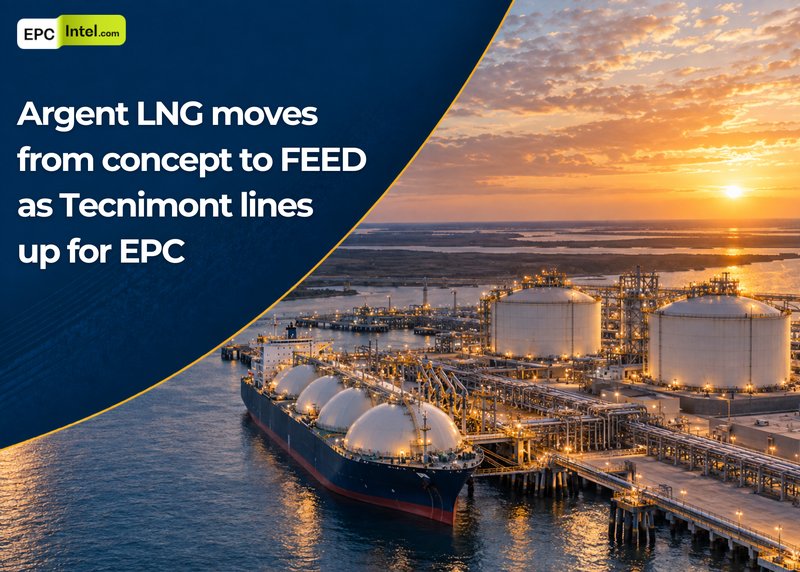
Argent LNG has taken another important step toward turning its Port Fourchon LNG concept into a construction project.
Tecnimont USA has signed the FEED contract covering engineering, project execution planning, cost and schedule development, safety and reliability studies, technology integration and support for the FERC permitting process.
On its own, that is a conventional FEED scope. What makes this one interesting is what comes next.
MAIRE says that following FEED completion, FERC permitting and Argent LNG’s Final Investment Decision, the project is expected to roll into EPC. Earlier this year, MAIRE described Tecnimont’s intended position as EPC integrator and called Argent LNG a multibillion-dollar development involving multiple packages and OEMs.
In other words, Tecnimont is getting involved while the plant configuration, execution strategy and procurement architecture are still being defined.
A very large LNG supply chain is taking shape
Argent LNG is planned at Port Fourchon, Louisiana, with ultimate capacity of 25 MTPA. The developer says the project will be phased, starting at around 12 MTPA, with initial operations targeted for 2030. Argent currently describes Phase 1 as approximately a $10 billion investment.
The regulatory documentation gives a clearer picture of what contractors will eventually have to build.
FERC lists 12 modular liquefaction units, five Honeywell UOP pretreatment units, two 220,000 cubic meter LNG storage tanks, two marine berths and dual feed-gas interconnections. DOE documentation additionally identifies an approximately 350 MW power generation facility.
Several major suppliers are therefore already sitting around the table.
[Baker Hughes is providing its NMBL modular LNG technology and LM9000-based equipment, while Honeywell UOP is associated with gas pretreatment. ABB is involved in electrical systems, while GIS Engineering is leading civil, marine and site infrastructure engineering. Argent itself now identifies Tecnimont as supporting FERC, FEED and EPC execution.
That leaves a substantial amount of procurement still to flow downstream.
Where the EPC money could go
Using comparable LNG EPC spending patterns in EPCIntel’s contract database and the developer’s approximately $10 billion Phase 1 investment figure, a reasonable indicative package split would look roughly like this:
| Package | Indicative share | Potential Phase 1 spend |
|---|---|---|
| Liquefaction and compression | 25-30% | $2.5-3.0bn |
| Gas pretreatment and process systems | 10-15% | $1.0-1.5bn |
| Power generation and electrical | 8-12% | $0.8-1.2bn |
| LNG storage | 8-10% | $0.8-1.0bn |
| Marine facilities and loading | 7-10% | $0.7-1.0bn |
| Civil, site and infrastructure | 8-12% | $0.8-1.2bn |
| Utilities, offsites and balance of plant | 10-15% | $1.0-1.5bn |
| Engineering, construction management and other costs | 8-12% | $0.8-1.2bn |
These are EPCIntel.com estimates rather than announced contract values, and individual packages will overlap depending on how Tecnimont and Argent ultimately structure EPC execution.
The modular strategy is particularly important for subcontractors. Much of the liquefaction equipment will be fabricated and tested away from Port Fourchon before being transported to Louisiana. That creates opportunities not only at the construction site, but across module fabrication, structural steel, piping, electrical systems, packaged equipment, logistics and heavy transport.
Tecnimont is positioning itself early
The bigger story is therefore not the value of the FEED contract.
It is Tecnimont’s attempt to enter the US LNG EPC market through an early-engagement model rather than arriving when the EPC tender is already fully defined.
MAIRE has explicitly described Argent LNG as part of its strategy to expand its LNG EPC capabilities while working with OEMs such as Baker Hughes.
If Argent clears permitting, financing and FID, Tecnimont could move from FEED engineer to EPC integrator on one of the larger LNG developments currently proposed on the US Gulf Coast.
For suppliers, that means the project is worth tracking now, not when construction starts. Procurement decisions made during FEED will determine how billions of dollars of liquefaction, tanks, power, marine infrastructure, modules, piping, electrical equipment and construction work eventually reach the market.