Angola has not been short of offshore ambition. What it has needed is sanction, contract conversion and a development model that makes deepwater barrels work in a mature basin. Greater PAJ now gives the market exactly that.
ANPG, Azule Energy, Sonangol E&P and Equinor have reached final investment decision on the USD 5.1 billion Greater PAJ project offshore Angola, creating the country’s first integrated cross-block development across Blocks 31 and 31/21.
That sounds technical, but the commercial meaning is simple. Instead of developing nearby discoveries as separate projects, Azule is bringing Palas, Astraea, Juno, Urano and Dione into one coordinated scheme, using common infrastructure where it makes sense and block-specific facilities where required. In a cost-sensitive offshore market, that is the difference between resources staying on a map and barrels getting produced.
Project scope
Greater PAJ will develop an estimated 252 million barrels of oil reserves, with around 143 million barrels in Block 31 and 108 million barrels in Block 31/21. First oil is expected in the first half of 2029.
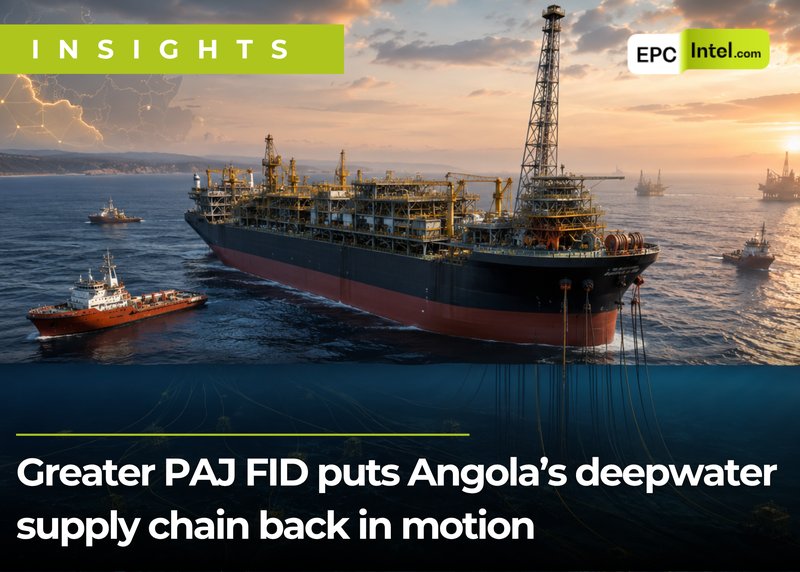
The development concept includes 17 wells, made up of 10 oil producers and 7 water injectors, tied back to a new FPSO with nameplate capacity of 95,000 barrels of oil per day. The project also includes gas export capacity of 70 million standard cubic feet per day, with gas routed toward Angola LNG through the Block 31 gas export network.
The fields sit in water depths reaching around 2,000 meters, which places Greater PAJ firmly in the ultra-deepwater category. That matters because this is not a simple tieback campaign. It is a full subsea-to-surface development with heavy demand for marine installation, subsea hardware, flexible and rigid pipe systems, umbilicals, FPSO integration and local fabrication support.
Contracting picture
The FID ceremony came with six core contract signatures, giving the project a clear execution structure.
CIMC Raffles has been selected for the FPSO package. Baker Hughes has secured the subsea production systems scope. OneSubsea is responsible for umbilicals. TechnipFMC will deliver risers and flowlines. Vallourec is attached to the rigid pipe package. Saipem has been awarded the transportation and installation contract.
The most transparent contract value so far is Saipem’s, at USD 1 billion. Its scope includes engineering, fabrication, transportation and installation of around 180 kilometers of rigid pipelines and subsea facilities, plus transportation and installation of 38 kilometers of flexible flowlines and jumpers and 54 kilometers of umbilicals. The work is expected to run for around 40 months.
TechnipFMC’s flexible pipe award has been classified by the company as “significant,” which under its reporting framework means a range of USD 75 million to USD 250 million. For a deepwater development of this scale, the upper half of that range looks plausible, although EPCIntel is treating it conservatively until a firmer figure is disclosed.
Package breakdown
Based on EPCIntel.com’s offshore FPSO and subsea project benchmarks, the USD 5.1 billion total capital spend is likely to break down roughly as follows.
The FPSO package is the largest single opportunity, likely in the USD 1.7 billion to USD 2.1 billion range. That includes hull conversion or newbuild elements, topsides modules, integration, commissioning support, marine systems, utilities, power generation and process equipment.
Subsea production systems should represent around USD 500 million to USD 700 million. This covers subsea trees, manifolds, control systems, distribution hardware and related engineering and testing.
SURF and installation is another major cost center. With Saipem’s USD 1 billion contract already confirmed, the combined subsea pipelines, risers, flowlines, umbilicals and installation market could sit around USD 1.3 billion to USD 1.6 billion when TechnipFMC, OneSubsea, Vallourec and associated subcontract scopes are included.
Drilling and completions could account for USD 900 million to USD 1.2 billion, depending on rig dayrates, well complexity and completion design. For 17 ultra-deepwater wells, this is not a marginal line item.
Local fabrication, logistics, marine support, brownfield tie-ins, inspection and commissioning could absorb another USD 300 million to USD 500 million. The project’s planned 1.8 million manhours of local content and more than 6,500 tonnes of structures, piles and risers create a meaningful in-country subcontracting opportunity.
Supplier opportunities
Greater PAJ is not only a win for the named contractors. It opens a long list of second-tier opportunities.
FPSO suppliers should watch for packages covering rotating equipment, power generation, compression, separators, valves, electrical systems, control systems, flare systems, marine loading, safety systems and topsides structural fabrication.
Subsea suppliers should track opportunities around connectors, subsea valves, controls, hydraulic systems, insulation, coatings, flying leads, ROV tooling, installation aids and testing services.
Marine subcontractors will be needed for survey, pre-lay work, trenching, metrology, heavy lift support, logistics, diving support, ROV services and offshore commissioning.
Angolan yards and service companies also have a real opening. The local content target is not decorative. With 1.8 million manhours expected, Greater PAJ should drive fabrication, assembly, support vessel, inspection, logistics and workforce training activity inside Angola.
Why it matters
Greater PAJ lands at a useful time for Angola. The country needs new deepwater projects to offset natural decline and maintain its position as one of Africa’s core oil producers. It also needs developments that can compete for capital without pretending that costs do not matter.
The cross-block model is the important part. By sharing common infrastructure, Greater PAJ improves project economics and reduces duplication. It also gives contractors a larger, more integrated scope to execute, which is exactly the kind of structure that global offshore contractors prefer.
For Azule Energy, this is another step in building a serious Angolan deepwater portfolio. For contractors, it is one of the most important African offshore awards of 2026. For suppliers, the main contracts are only the beginning.
Greater PAJ has now moved from concept to capital commitment. The next race is procurement.