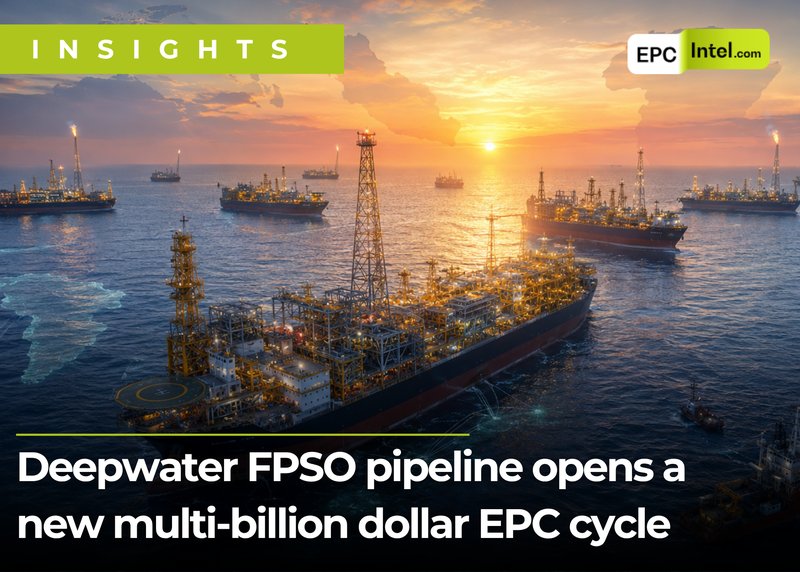
The next offshore cycle is not waiting for another grand theory about the death of oil. It is being welded together in shipyards, priced by package engineers, and fought over by the same contractors that survived the last downturn.
From the image, the top upcoming FPSO projects by capex are:
- Uaru, Guyana, ExxonMobil, US$12.7 billion, planned
- Whiptail, Guyana, ExxonMobil, US$12.7 billion, planned
- GranMorgu, Suriname, TotalEnergies, US$10.5 billion, planned
- Atapu Development, Brazil, Petrobras, US$9.741 billion, producing
- Raia, Brazil, Equinor, US$9.0 billion, planned
- Sepia Development, Brazil, Petrobras, US$8.499 billion, producing
- Buzios X Franco, Brazil, Petrobras, US$8.427 billion, planned
- Bonga Southwest/Aparo, Nigeria, Shell, US$8.0 billion, announced
- Buzios XI Franco, Brazil, Petrobras, US$7.641 billion, planned
- Buzios IX Franco, Brazil, Petrobras, US$7.079 billion, planned
The real story is execution capacity
FPSOs are back at the center of offshore spending because deepwater operators have learned a simple lesson. If the reservoir is large enough, the fastest way to monetize it is not to wait for a perfect fixed platform concept. It is to secure floating production capacity, lock in subsea execution, and get barrels moving.
That is why Guyana, Brazil, Suriname and Nigeria dominate this ranking. These are not marginal projects looking for a marketing story. They are developments with enough scale to justify multi-billion dollar production systems, complex subsea networks, major mooring packages, topside modules, export systems and long-term offshore operations support.
ExxonMobil’s Uaru and Whiptail projects sit at the top with values of US$12.7 billion each. That is a clear signal that Guyana remains one of the most important offshore EPC markets in the world. The country has moved from discovery province to industrial execution machine, and every new FPSO keeps pressure on hull capacity, topside integration yards, subsea vendors and offshore installation contractors.
Brazil remains the anchor market
Brazil is the real heavyweight in the list. Petrobras is tied to Atapu, Sepia and the Buzios IX, X and XI Franco developments, while Equinor’s Raia adds another major Brazilian FPSO-linked investment.
This is exactly why suppliers keep Brazil at the top of their offshore priority list. Petrobras projects are rarely small, rarely simple, and rarely short on procurement scope. A single large FPSO development can generate opportunities across engineering, hull conversion or newbuild work, topside fabrication, subsea trees, manifolds, risers, flowlines, umbilicals, flexible pipe, power systems, rotating equipment, valves, process modules, accommodation, marine systems and long-term maintenance.
For EPCIntel.com’s package view, a US$8 billion to US$10 billion FPSO development can typically split into several major opportunity pools. The FPSO hull, topsides and integration package can account for roughly 35 to 45 percent of project capex. Subsea production systems and SURF can take another 25 to 35 percent. Drilling and completions often sit in the 15 to 25 percent range, depending on well count and reservoir complexity. Export infrastructure, logistics, commissioning and owner costs make up the rest.
That means even a project like Buzios IX, shown at US$7.079 billion, can represent a multi-billion dollar contracting opportunity before first oil is reached.
Suriname steps into the big league
TotalEnergies’ GranMorgu project, listed at US$10.5 billion, is the clearest sign that Suriname is no longer just “the next Guyana” in investor presentations. It is now becoming a real offshore EPC market.
The key opportunity here is not only the FPSO itself. GranMorgu creates demand for subsea production infrastructure, deepwater installation vessels, pipe-lay capability, umbilicals, flexible systems, mooring, offshore logistics and local fabrication support. For major offshore contractors, it is the kind of project that justifies serious commercial attention because it opens a new basin with follow-on potential.
Nigeria returns with Bonga Southwest/Aparo
Shell’s Bonga Southwest/Aparo, shown at US$8.0 billion, brings Nigeria back into the FPSO conversation. The country has always had deepwater potential, but the timing of major projects has been slowed by fiscal, political and execution complexity.
If Bonga Southwest/Aparo moves through the contracting cycle, it will be a major test of Nigeria’s ability to bring offshore megaprojects back to market at scale. For EPC and marine contractors, the prize is obvious. A Nigerian FPSO development of this size means hull and topsides work, subsea systems, installation campaigns, local content packages, logistics bases, fabrication yards and years of operational support.
What contractors should watch
The biggest bottleneck in this cycle will not be project ambition. It will be available execution capacity.
FPSO yards, module fabricators, subsea suppliers and installation vessel owners are all entering a tighter market. Operators want faster schedules and lower costs, but the supply chain is not infinitely elastic. The contractors that can offer repeatable FPSO execution, standardized topsides, early procurement discipline and integrated subsea delivery will be in the strongest position.
The top 10 projects in the image represent more than US$94 billion of listed capex. Even if only a portion of that flows directly into EPC and major supply contracts, the opportunity pool is enormous.
This is the offshore cycle in its most practical form: fewer slogans, more steel, more modules, more subsea hardware, and a lot more competition for the companies that can actually deliver.