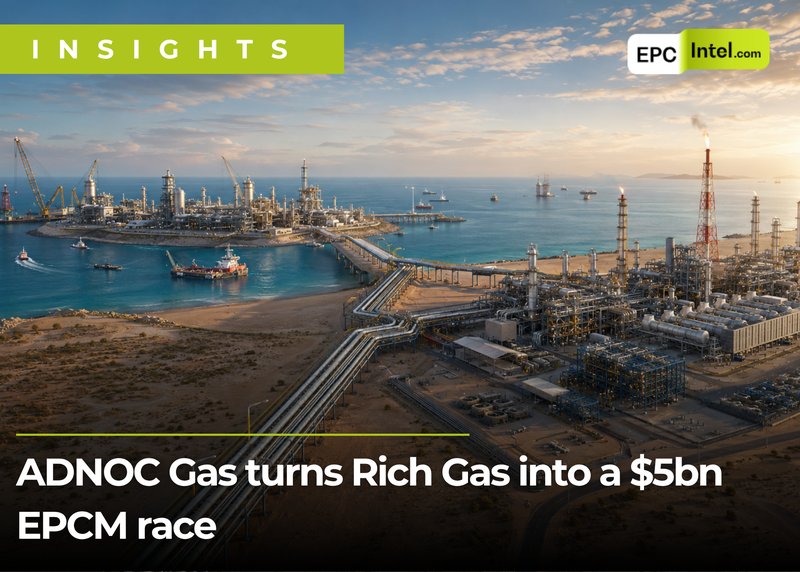
ADNOC Gas has put serious money behind its next processing expansion, and this is not a small brownfield clean-up job dressed up as a megaproject.
The company’s $5bn Rich Gas Development Phase 1 programme is a major capacity push across some of the UAE’s most important gas processing assets. The confirmed awards put Wood, Petrofac and Kent at the centre of the execution campaign, with work spread across Habshan, Das Island, Asab and Buhasa.
That makes the project one of the most important UAE gas EPCM award packages currently moving through the market.
Contractors take the big seats
The largest tranche has gone to Wood, which secured a $2.8bn EPCM contract for the Habshan facility. Habshan remains one of the core pillars of ADNOC’s gas processing system, so this is the strategic heart of the programme.
Petrofac has taken the $1.2bn Das Island package, covering expansion works tied to new inlet facilities and two gas dehydration and compression trains. Each train is designed for around 420 mmscfd, making this a meaningful offshore gas handling upgrade rather than a marginal add-on.
Kent secured the $1.1bn Asab and Buhasa package, focused on optimisation, debottlenecking and brownfield expansion across existing gas processing facilities.
Together, these three packages form the confirmed contractor landscape. Other names have circulated around the broader ADNOC gas ecosystem, including Wison, KBR, Target Engineering, NMDC Energy, Galfar and CPECC, but for this specific confirmed award set, EPCIntel would treat them as unverified unless primary contract evidence appears.
Why this matters
The UAE has a simple problem, and it is a good one to have.
ADNOC wants to grow upstream production capacity while also extracting more value from associated gas and rich gas streams. That means more compression, more dehydration, more processing, more liquid recovery and more transfer infrastructure.
The Rich Gas Development programme sits directly inside that logic.
Oil production growth only works if the gas handling system can keep pace. Every extra barrel of offshore or onshore production brings associated gas that must be processed, treated, compressed, transported and integrated into the national energy system. If gas processing capacity lags, production flexibility tightens.
That is why this programme matters beyond the headline contract value. It supports ADNOC’s wider production growth ambition, strengthens domestic gas supply, and increases the UAE’s ability to capture liquids and value-added gas streams rather than leaving molecules underutilised.
Package spend breakdown
Based on EPCIntel’s benchmark database for large brownfield gas processing and offshore-to-onshore gas integration programmes, the $5bn EPCM campaign could translate into the following capital allocation across major packages:
| Package area | Estimated share | Estimated value |
|---|---|---|
| Gas compression systems | 22% | $1.10bn |
| Gas dehydration and treating units | 14% | $700m |
| Brownfield processing modifications | 16% | $800m |
| Pipelines and transfer systems | 13% | $650m |
| Electrical, control and instrumentation | 10% | $500m |
| Civil, structural and buildings | 8% | $400m |
| Rotating equipment balance of plant | 7% | $350m |
| Utilities, flare and offsites | 6% | $300m |
| Engineering, project management and commissioning | 4% | $200m |
The biggest opportunities will sit with compressor OEMs, gas treatment technology suppliers, pressure vessel fabricators, E&I contractors, modular skid suppliers, valve manufacturers, pipeline contractors and brownfield construction specialists.
This is exactly the kind of programme where main EPCM awards are only the first layer. The real market action follows in procurement packages, specialist construction awards and equipment supply contracts.
Petrofac gets the offshore complexity
Petrofac’s Das Island role is particularly interesting.
Das Island is not an easy execution environment. It is an operating offshore industrial hub with space limitations, tie-in risk and strict shutdown planning requirements. Adding new inlet facilities and dehydration and compression trains means the contractor has to work around live infrastructure while protecting production continuity.
That plays into Petrofac’s historical strength in Middle East brownfield gas, offshore processing and complex tie-in execution.
For suppliers, the Das Island package should generate strong demand for compressors, dehydration systems, separators, pressure vessels, E&I works, control systems, flare modifications and modularised process units.
Wood gets the scale play
Wood’s $2.8bn Habshan award is the anchor contract.
Habshan is one of the UAE’s most important gas processing centres, so this package is likely to carry the largest process integration and brownfield coordination load. The scale of the award suggests major throughput enhancement, plant modifications, compression integration and utilities upgrades.
This is not just engineering. It is programme management, procurement strategy, constructability, tie-in sequencing and commissioning discipline across a critical national energy asset.
For the EPC supply chain, Habshan should be the richest hunting ground.
Kent strengthens its ADNOC position
Kent’s $1.1bn Asab and Buhasa award reinforces its position in UAE gas infrastructure.
These facilities are already part of ADNOC’s mature gas processing backbone. The opportunity is not about building a clean-sheet plant. It is about squeezing more capacity, reliability and efficiency from existing assets.
That tends to favour contractors with strong brownfield capability, local execution teams and familiarity with ADNOC standards.
The EPCIntel view
The ADNOC Gas Rich Gas Development awards show where the Middle East gas market is heading.
The next wave of spending is not only LNG export terminals or greenfield megaprojects. It is also high-value brownfield gas infrastructure, compression, debottlenecking and processing capacity that unlocks upstream production growth.
For Wood, Petrofac and Kent, this is a major vote of confidence.
For the supply chain, the message is clear: the big contracts have landed, but the package-level race is just getting started.