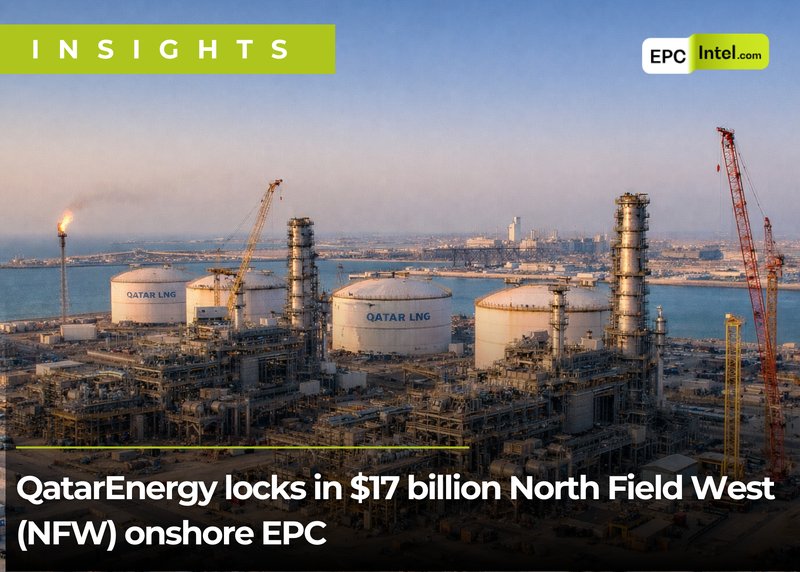
QatarEnergy has moved another decisive piece on the global LNG chessboard, awarding the onshore EPC contract for the North Field West, NFW, project that will push national liquefaction capacity to 142 MTPA. With two mega trains totaling 16 MTPA, NFW completes the trio of expansions that began with North Field East and North Field South, cementing Qatar’s position at the top of the LNG league table well into the next decade.
The contract covers two LNG trains, gas treatment, NGL recovery and helium extraction, plus associated utilities and offsites. In liquids terms, the scheme is expected to yield around 175,000 barrels of oil equivalent per day of condensate, ethane and LPG, adding another revenue stream alongside LNG. First cargo is targeted by end 2031, keeping the buildout cadence aligned with global supply tightness expected in the early 2030s.
The EPC award has gone to a joint venture between Technip Energies, Consolidated Contractors Company and Gulf Asia Contractor. For Technip Energies, this reinforces its dominance in mega LNG train execution following earlier North Field awards. For CCC and GAC, the prize is clear, long duration onshore construction at Ras Laffan with massive stick built and modular scopes.
EPC value and package breakdown
QatarEnergy has not disclosed the contract value, but based on EPCIntel.com database benchmarks for recent 8 MTPA class trains in the Gulf, a single mega train with full gas treatment and utilities typically ranges between USD 8 billion and USD 10 billion EPC value depending on integration scope and owner furnished equipment. With two trains plus CCS and jetty boil off gas recovery integration, the total onshore EPC package for NFW likely sits in the USD 15 billion to USD 18 billion range.
A typical capital split for a 16 MTPA two train configuration would look as follows. LNG process units and liquefaction systems account for roughly 35 to 40 percent of EPC value. Utilities, power generation and water systems represent around 15 percent. Storage tanks and loading facilities add about 10 percent. Gas treatment and NGL recovery come in near 15 percent. Buildings, civil works and infrastructure can absorb another 10 to 15 percent. The balance sits in engineering, project management and indirects.
For subcontractors and suppliers, this translates into multi billion dollar opportunities in cryogenic heat exchangers, compressors, gas turbines, storage tanks, structural steel, electrical systems and instrumentation. Helium extraction also opens specialized processing packages that have become more attractive as global helium markets tighten.
CCS and decarbonization overlay
NFW is not just about volume. The project integrates 1.1 MTPA of carbon capture and sequestration capacity, aligned with QatarEnergy’s ambition to capture more than 11 MTPA of CO2 by 2035. In addition, jetty boil off gas recovery will cut emissions equivalent to 0.42 MTPA of CO2. A significant share of electrical demand will be supplied from Qatar’s solar plants, further lowering the carbon intensity per ton of LNG.
From an EPC perspective, CCS typically represents 5 to 8 percent of total plant EPC for integrated capture and compression, depending on reservoir tie in and injection well scope. This adds a specialized layer of compression trains, dehydration, pipelines and monitoring systems, all of which create targeted opportunities for niche technology providers and rotating equipment suppliers.
Execution strategy and contractor positioning
The signing ceremony in Doha brought together H.E. Saad Sherida Al Kaabi, Arnaud Pieton of Technip Energies, Samer Khoury of CCC and Ravi Pillai of GAC. The message was clear, continuity and scale. NFW follows the template set by North Field East and South, leveraging design replication and execution learning curves to reduce risk and compress schedule.
For Technip Energies, this secures backlog visibility deep into the next decade and reinforces its LNG franchise at Ras Laffan. For CCC and GAC, the construction heavy lifting on foundations, concrete, steel erection and mechanical installation will drive workforce peaks in the tens of thousands at site.
With first cargo expected by end 2031, the clock is now ticking on detailed engineering, early procurement of long lead items such as main cryogenic heat exchangers and gas turbines, and mobilization of major subcontract packages. For suppliers tracking the LNG cycle, NFW represents one of the last mega awards in this expansion wave, but also a bridge to the next round of global FIDs.
At 142 MTPA capacity, Qatar is not just expanding, it is redefining scale. For the EPC market, North Field West is another reminder that LNG remains the heavyweight of global upstream and midstream capital allocation.