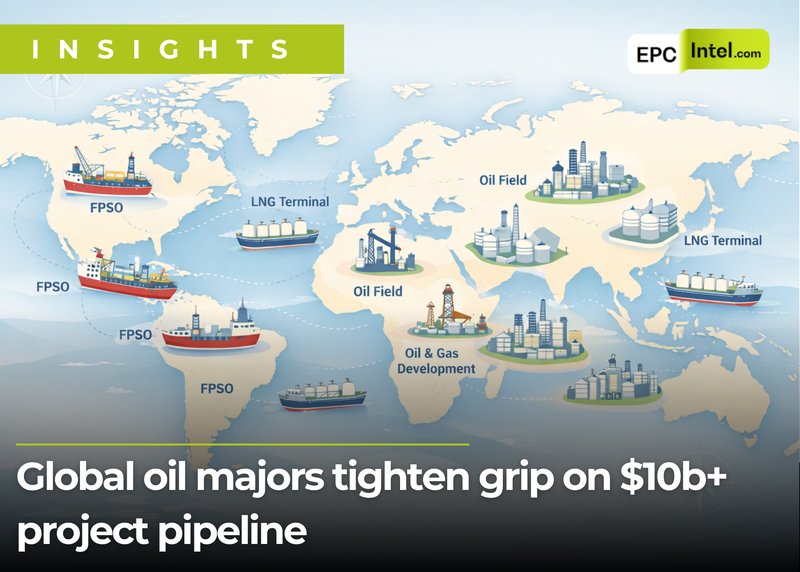
The biggest shift in global oil and gas is not just the scale of investment, it is the way that capital is being structured into long term, repeatable project pipelines. Companies like ExxonMobil, Saudi Aramco, and TotalEnergies are no longer executing standalone megaprojects. They are building multi phase development programs that extend over a decade, effectively locking in continuous EPC demand.
Standardization reshapes offshore execution
In Guyana, ExxonMobil has demonstrated how repeatability can transform project economics. Instead of treating each offshore development as unique, the company is deploying a series of FPSOs based on standardized designs, aligned supply chains, and repeat contractor frameworks. Petrobras is following a similar path in Brazil, where successive deepwater projects are structured to reuse engineering and procurement strategies.
Typical capital allocation across these offshore developments remains consistent, with FPSO units often ranging between $1.5B and $3B, while subsea systems account for another $1B to $2B. This consistency is what allows contractors to move from competitive bidding toward long term positioning within a development program.
Downstream hubs evolve into multi phase ecosystems
In the Middle East, Saudi Aramco and ADNOC are redefining downstream strategy. Projects like Jubail and Ruwais are no longer single investments, they are industrial platforms that evolve over multiple phases, moving from refining expansion into petrochemicals and eventually into specialty products and lower carbon integration.
From an EPC perspective, the largest value continues to sit in process units, particularly steam crackers and derivative facilities, which typically account for up to half of total capital spend. Utilities, offsites, and infrastructure packages follow, creating layered contracting opportunities across each expansion phase.
LNG strategies extend far beyond first gas
Gas monetization strategies led by bp, Shell, and CNOOC are increasingly structured around expansion from day one. Projects are designed not just to deliver initial capacity, but to accommodate future trains, debottlenecking, and tiebacks.
This creates a rolling EPC pipeline where early phase contractors are often best positioned to capture follow on work. With LNG trains exceeding $5B and floating LNG units typically in the $2B to $3B range, even incremental expansions represent significant contract value.
Integrated developments unlock parallel opportunities
TotalEnergies and Eni are pushing integration further by linking upstream production directly with export infrastructure. In regions like East Africa and North Africa, upstream facilities trigger pipeline development, which in turn drives investment in terminals and supporting infrastructure.
This creates multiple EPC tracks running in parallel rather than a single project lifecycle. Pipelines alone can represent $3B to $5B of capital, while upstream and processing facilities account for a similar share, effectively doubling the addressable EPC market for a single development.
Scale reinforces contractor consolidation
Mega projects such as Chevron’s Tengiz expansion highlight how execution scale is narrowing the field of capable contractors. With total investments exceeding $40B, these developments require a combination of engineering depth, modular construction capability, and global logistics that only a handful of players can deliver.
As a result, operators are increasingly relying on a core group of contractors across multiple phases and projects, reinforcing long term partnerships and reducing reliance on one off competitive tenders.
EPCIntel.com insight
The strategic shift is clear. Oil majors are no longer competing project by project, they are building controlled pipelines of developments that extend over years and across regions.
For EPC contractors and suppliers, the implication is fundamental. Success is no longer defined by winning a single flagship contract, but by securing a position within a broader development ecosystem where repeat work, standardization, and long term relationships drive value.
In this new landscape, the most valuable contract is not the one you win today. It is the one that keeps repeating tomorrow.