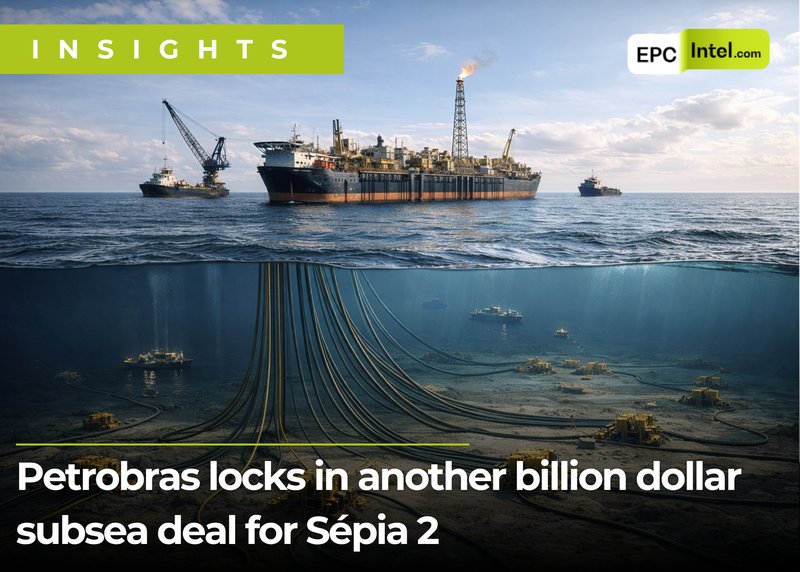
Subsea7’s latest award from Petrobras for the Sépia 2 development reinforces a familiar pattern, Brazil’s pre-salt is once again driving multi-billion dollar subsea contracting cycles. Described as a supermajor contract by Subsea7, the award sits comfortably above the $1.25 billion threshold and anchors one of the largest SURF packages moving toward execution in the current offshore pipeline.
The scope covers full EPC delivery of subsea umbilicals, risers and flowlines for 17 wells, including tie-ins to existing Sépia 1 infrastructure, alongside a gas export system with 18 risers. With offshore works scheduled from 2029, the contract aligns directly with the next FPSO delivery cycle in Brazil’s pre-salt Santos Basin.
A cornerstone project in Petrobras’ next phase
Sépia 2 is not just another incremental expansion. It is part of Petrobras’ second wave of large-scale pre-salt growth, built around new generation FPSOs targeting ~225,000 barrels per day capacity. Alongside Atapu 2, it forms a central pillar of Brazil’s production growth strategy heading into the next decade.
What makes this award particularly important is timing. With FPSO contracts already placed and subsea packages now moving into execution, the project has clearly transitioned from concept to full-scale delivery mode. That shift typically unlocks the majority of supply chain spending.
Where the real money flows
While the headline contract sits above $1.25 billion, the value distribution across packages is where EPC and supplier opportunities become visible.
For a SURF package of this scale, EPCIntel data suggests the following capital split:
- Rigid risers and flowlines: 30% to 35%
- High-spec steel, coatings, welding and pipe manufacturing dominate this segment, making it the single largest value block.
- Umbilicals and subsea distribution: 15% to 20%
- Includes umbilicals, termination units, flying leads and control systems, a key entry point for specialized subsea OEMs.
- Offshore installation: 25% to 30%
- Vessel time, installation campaigns, heavy lift and deepwater execution services represent a major cost driver, particularly in ultra-deepwater.
- Fabrication and spoolbase operations: 10% to 15%
- Local fabrication yards and spoolbases benefit heavily here, especially under Brazil’s local content framework.
- Engineering, project management and pre-commissioning: 10% to 15%
- Front-end engineering, integration and commissioning services round out the package.
On a base case of $1.25 billion, that translates into roughly $400 million for risers and flowlines, $200 million for umbilicals, $350 million for installation, and $150 million each for fabrication and engineering scopes.
Subcontracting hotspots to watch
This contract will cascade into a wide supplier ecosystem. Key opportunity areas include:
- Steel pipe mills and coating providers tied to rigid flowline manufacturing
- Umbilical system suppliers and subsea hardware OEMs
- Offshore installation vessel operators and marine subcontractors
- Local Brazilian fabrication yards and assembly facilities
- Inspection, testing and commissioning specialists
Brazil’s local content requirements will play a decisive role in how this value is distributed. Previous Petrobras SURF awards have pushed local participation above 50%, and Sépia 2 is expected to follow a similar trajectory, reinforcing domestic fabrication and assembly demand.
EPCIntel.com takeaway
This is exactly the type of contract that signals a full-cycle offshore development moving into execution. The combination of high well count, deepwater complexity and integration with a large FPSO platform positions Sépia 2 as one of the defining subsea projects of the late decade.
For Subsea7, it strengthens an already dominant position in Brazil’s SURF market. For Petrobras, it confirms that the next wave of pre-salt production growth is now firmly under construction.
And for the supply chain, this is where the real story begins. Once subsea contracts of this scale are awarded, the downstream flow of EPC packages, fabrication work and equipment supply tends to accelerate quickly, creating a multi-year pipeline of opportunities well beyond the headline contract value.