After more than a decade of stalled attempts, shifting operatorships and repeated redesigns, the Sea Lion development has finally crossed into execution. Rockhopper and operator Navitas have both taken FID on Phase 1, triggering a USD 1.8 billion spend to First Oil and a total USD 2.1 billion requirement to project completion. For a basin written off by many as stranded, this move drags the North Falkland Islands back into the upstream conversation and sets up a rare frontier FPSO development in a market dominated by Brazil, Guyana and West Africa.
What makes this milestone significant is not just the capital commitment. It is the structural shift behind it. The Falkland Islands Government has approved the field development plan for both Phase 1 and Phase 2. Licences now move into a 35 year exploitation period. Financing has been locked down through a USD 1.0 billion senior debt package, supplemented by joint venture equity and post First Oil cash flows. The operator has quietly secured the critical commercial contracts needed to progress the project. In short, Sea Lion is no longer a theoretical play. It is a funded, sanctioned oil development with a defined path to installation.
A frontier FPSO returns
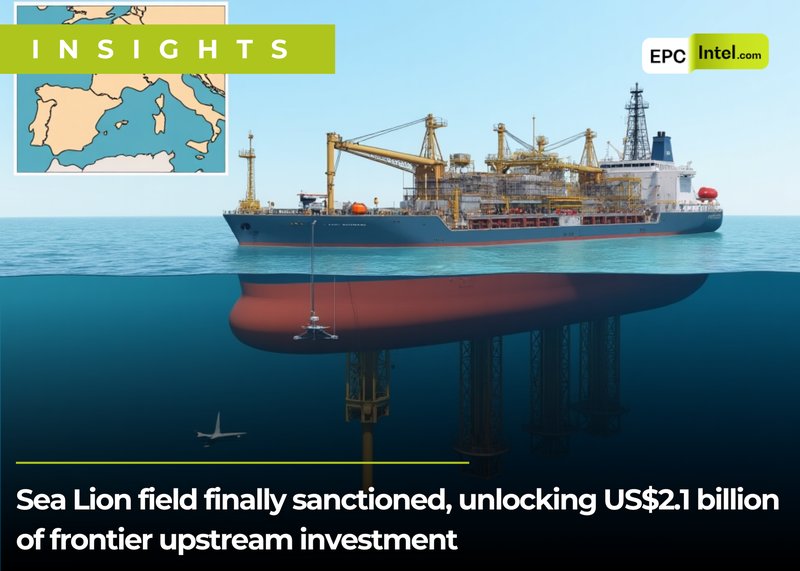
Phase 1 targets 170 million barrels at a peak of 50,000 barrels per day. Production will be hosted on a chartered FPSO with associated EPC and O and M agreements already signed. A full SURF EPCIC award covers umbilicals, risers, flowlines and subsea installation. A drilling rig contract and a framework for drilling and completions services are also in place. These are the backbone packages of any FPSO development and their execution readiness signals that Navitas has prepared for a fast transition into the construction window.
This matters because frontier FPSO work behaves differently from mature basin campaigns. Mobilisation is longer. Weather windows are tighter. Logistics are complex and heavily reliant on reliable local ports and marine spreads. Contractors will see opportunities across turret mooring packages, topsides integration scopes, subsea hardware, flexible pipe systems and long haul installation campaigns. Although Navitas has not publicly confirmed its supplier selections, the scale and sequencing point to a multi year execution program with substantial global content.
Capital cost structure
Based on EPCIntel’s database of greenfield FPSO developments of similar scale, the USD 2.1 billion post FID program likely splits into the following approximate ranges.
• FPSO charter, topsides integration and mooring: 35 to 40 percent, roughly USD 735 to 840 million.
• SURF system, umbilicals, risers, flowlines and installation: 25 to 30 percent, about USD 525 to 630 million.
• Drilling and completions for the pre drilled and future wells: 20 to 25 percent, roughly USD 420 to 525 million.
• Subsea equipment and control systems: 10 to 15 percent, USD 210 to 315 million.
• Project management, engineering and contingency: the remaining 5 to 10 percent.
These ranges align with typical deepwater FPSO tiebacks and greenfield analogue projects, although the final cost structure will depend on the FPSO contracting strategy, rig day rates and installation vessel availability. For local and regional contractors, the biggest accessible scopes will be logistics, marine support, subsea fabrication assistance and in region integration support for selected packages.
Financing locked in
A key shift behind FID is the completion of a USD 1.0 billion senior debt package with a 7 year tenor. This includes USD 350 million allocated to Rockhopper. Margin ranges from SOFR + 525 bps pre completion, tapering to lower spreads post completion. Mandatory hedging requirements apply during the early production years. The structure mirrors other frontier FPSO financings that rely heavily on project finance against long life barrels.
For Rockhopper, the equity requirement is efficient. Net equity needed is about USD 102 million, plus approximately USD 10 million in equity overrun support. This is materially lower than historical iterations of the project due to the Navitas carrying arrangement and phased development plan.
One element that has shifted is early project failure support. The estimated requirement from the Falkland Islands Government has increased to USD 52.5 million, up from USD 40 million. Rockhopper is evaluating surety options and cash backed instruments to meet this commitment. While the figure is larger, it does not alter the ability of the joint venture to proceed at FID.
Next steps toward first oil
Financial Close remains the final condition. Once complete, it triggers Rockhopper’s USD 140 million placing and the launch of an open offer. All conditions precedent are at an advanced stage and are expected to be satisfied within weeks. Navitas will then move into execution, paving the way for First Oil in 2028.
Sea Lion does not challenge Brazil or Guyana in scale, but that is not the point. It resurfaces a frontier province, brings a long dormant resource into development and plants a modern mid sized FPSO in a basin that has watched a decade of global growth from the sidelines. The key commercial contracts are signed. The financing is complete. The window is open. For the supply chain, this is one of the rare opportunities to engage in a new basin rather than an incremental one.