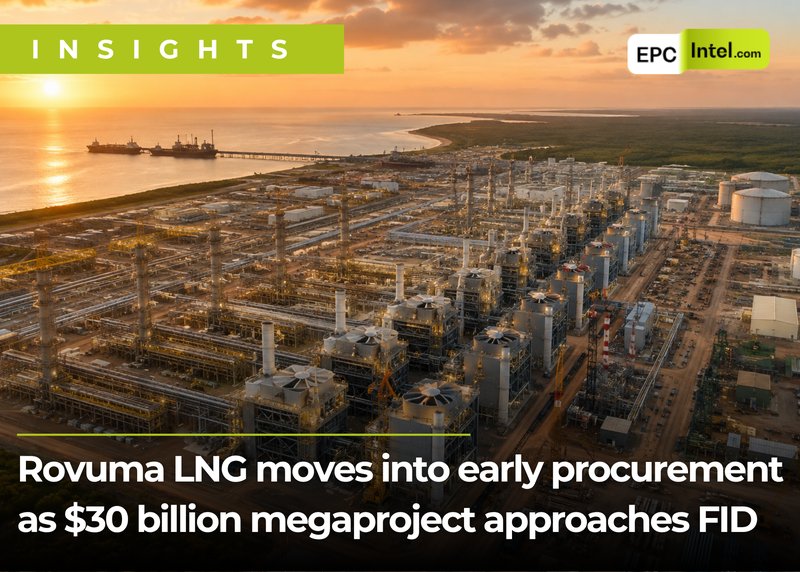
ExxonMobil’s Rovuma LNG development has taken another important step toward full execution, with the McDermott-led SMDC joint venture receiving a letter of intent covering limited engineering and procurement work for the 18.6 million tonnes per annum project in Mozambique.
The award is not yet the main EPC contract. But for contractors and suppliers watching one of the largest LNG developments still waiting to enter construction, it is arguably more interesting than another round of FEED work.
McDermott Energy Solutions (UK) Limited is the majority shareholder in SMDC, alongside Saipem, Daewoo Engineering & Construction and China Petroleum Engineering & Construction Corporation (CPECC). ExxonMobil Moçambique awarded the LOI on behalf of the Area 4 partners.
From FEED competition to execution
McDermott, Saipem and CPECC were already involved in Rovuma LNG through the competitive FEED programme launched in 2024. That scope covered the modular design of the greenfield LNG facility at Afungi, including gas pretreatment, utilities, offsites and preparation of an EPC proposal.
The latest development takes that relationship further.
The SMDC team now includes Daewoo E&C, while McDermott says the LOI includes limited engineering and procurement activities supporting continued project definition ahead of final investment decision.
More importantly, McDermott will execute inside battery limits engineering, including the liquefaction modules, from London and Gurgaon, while personnel will be seconded to the joint venture project management team in Milan.
That gives the SMDC companies considerably greater visibility over the project as ExxonMobil approaches the point where billions of dollars of procurement could begin moving through the supply chain.
Twelve LNG modules change the contracting equation
Rovuma LNG is no conventional two or three-train LNG plant.
The updated development uses a modular electric LNG concept. ExxonMobil’s original FEED announcement described 12 liquefaction modules of approximately 1.5 mtpa each, fabricated away from Mozambique and assembled at Afungi. The strategy is intended to reduce construction activity at site, improve execution certainty and reduce emissions.
McDermott now puts total planned production capacity at 18.6 mtpa.
For the supply chain, modularisation shifts a substantial part of the opportunity away from conventional site construction and toward fabrication yards, module integrators, equipment manufacturers and global logistics contractors.
Large procurement packages should include compressors and electric drive systems, cryogenic heat exchangers, process vessels, piping, valves, instrumentation, electrical equipment, substations, structural steel, modular buildings, tanks and loading infrastructure.
Where the money could go
Rovuma LNG has widely been described as an approximately $30 billion development, although ExxonMobil has not publicly broken down the current sanctioned value because FID has not yet been taken.
Based on EPCIntel benchmarking of comparable large LNG developments, an indicative capital allocation for a project of this scale could look broadly like:
- Liquefaction and process modules: $8 billion to $10 billion
- Utilities, power and electrical infrastructure: $3 billion to $4 billion
- LNG storage, marine and export facilities: $2 billion to $3 billion
- Gas treatment and associated process facilities: $2 billion to $3 billion
- Module fabrication and structural works: $2 billion to $3 billion
- Pipelines, infrastructure and site development: $2 billion to $3 billion
- Engineering, construction management, commissioning and contingency: several billion dollars
These are EPCIntel estimates rather than announced package values, but they illustrate why Rovuma LNG will matter far beyond the four companies currently sitting inside SMDC.
A modular facility containing 12 liquefaction units will require a global fabrication and equipment supply chain, potentially creating hundreds of subcontracting and vendor packages before construction peaks in Mozambique.
FID is now the number to watch
ExxonMobil said in May that the Area 4 partners were targeting FID during the third quarter of 2026, with first LNG previously targeted for 2030.
McDermott’s August update now describes project start-up as anticipated in 2031, suggesting the execution schedule has continued to evolve as engineering progresses.
Area 4 is operated through Mozambique Rovuma Venture, owned by ExxonMobil, Eni and CNPC, which collectively holds 70%, while ENH, KOGAS and the remaining concession partner each hold 10%. ExxonMobil leads construction and operation of the LNG facilities.
The LOI still stops short of the full EPC commitment.
But with engineering continuing, procurement beginning and the preferred execution team increasingly taking shape, Rovuma LNG is moving out of the design competition and toward the stage suppliers have been waiting for.
If FID lands, this will not simply be another LNG project entering construction. It will be one of the biggest new EPC markets of the decade.