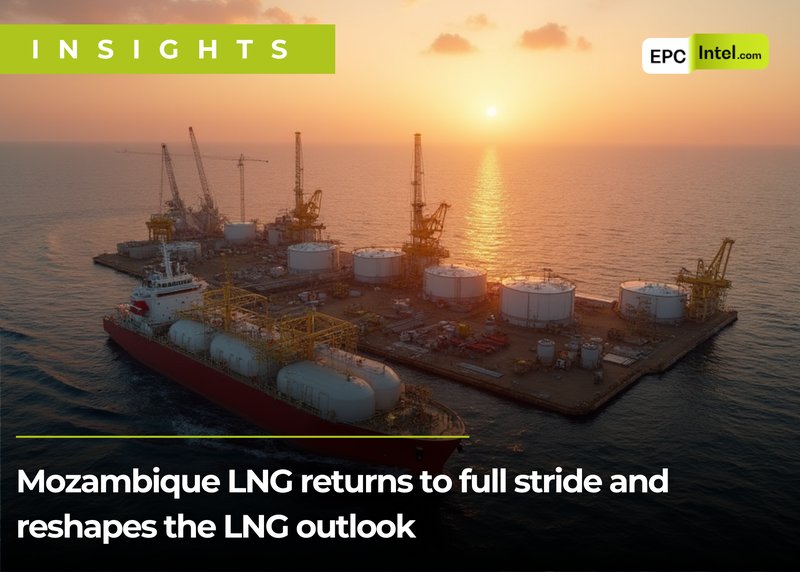
After a long period of uncertainty, one of the world’s largest and most important greenfield LNG projects is moving back into full execution, bringing scale, confidence, and long term supply back into a market that has been running thin.
The announcement in Afungi by TotalEnergies CEO Patrick Pouyanné, together with Daniel Chapo, confirms the resumption of all project activities at Mozambique LNG. Force majeure, in place since 2021, was lifted in November 2025, and construction has now restarted both onshore and offshore. More than 4,000 workers are already mobilized, with Mozambican nationals making up the majority of the workforce.
This is not a symbolic step. It is a return to large scale LNG execution.
Clearing up the restart timeline
Some activity around Mozambique LNG began earlier, which led to confusion about the project’s status. In early 2025, Saipem confirmed that it was resuming certain offshore and preparatory works.
Those moves were important signals, but they were limited in scope and took place while force majeure was still in effect. They reflected improving conditions and contractor readiness, not a full project restart.
The current announcement is broader and far more consequential. Force majeure has been lifted, construction is restarting across the site, and the operator and government are aligned behind a shared execution plan. That shift is what makes this moment stand out.
A project the LNG market has been waiting for
Mozambique LNG, with planned capacity of 12.9 mtpa, has always been too large to ignore. Its absence from the supply pipeline has been felt quietly but consistently over the past few years.
Global LNG demand has grown faster than expected, driven by Europe’s structural move away from Russian gas and continued growth in Asia. At the same time, new project sanctions slowed as cost inflation and supply chain constraints weighed on investment decisions.
Against that backdrop, Mozambique LNG’s return restores a meaningful volume of future supply. It strengthens the medium to long term LNG balance and adds diversity to a market increasingly concentrated in a handful of regions.
Restarting with a strong foundation
One of the reasons this restart carries weight is the amount of progress already made. During the force majeure period, engineering work continued and procurement of major equipment was largely completed. Overall project progress now stands at around 40 percent.
That puts Mozambique LNG well ahead of many greenfield LNG projects still navigating early development hurdles. With first LNG targeted for 2029, the project is moving on a timeline that reflects how much groundwork has already been laid.
In today’s LNG environment, that degree of readiness is a competitive advantage.
Security alignment supports execution
Security in Cabo Delgado remains a central consideration, and it featured prominently in the restart announcement. The Mozambican government reaffirmed the measures taken to stabilize the region and confirmed continued cooperation with Rwanda.
This alignment between operator and government provides a clearer framework for execution and underpins confidence among contractors, lenders, and insurers. It also reinforces the sense that Mozambique LNG is moving forward with a more resilient operating model than before.
A boost for Mozambique’s economy
The economic impact of Mozambique LNG is substantial. During construction, up to 7,000 Mozambicans are expected to be employed directly. Contracts awarded to local companies are projected to exceed USD 4 billion, injecting long term value into the national economy.
Beyond construction, the Mozambique LNG Foundation, established in 2023 with a USD 200 million endowment, is already delivering tangible benefits. Thousands of jobs have been created, and local farmers and fishermen in Cabo Delgado are receiving ongoing support.
These elements strengthen the project’s local footprint and reinforce its role as a cornerstone development for the country.
A meaningful shift for global LNG
Mozambique LNG returning to execution is more than a project level milestone. It marks the re entry of one of the LNG market’s most important growth projects at a time when new supply remains scarce.
For Mozambique, it accelerates the country’s emergence as a major LNG exporter. For the global LNG industry, it brings back scale, diversity, and long term supply visibility.
After years on the sidelines, Mozambique LNG is once again shaping the future LNG landscape, and the industry will be watching closely as this long awaited chapter moves forward.