
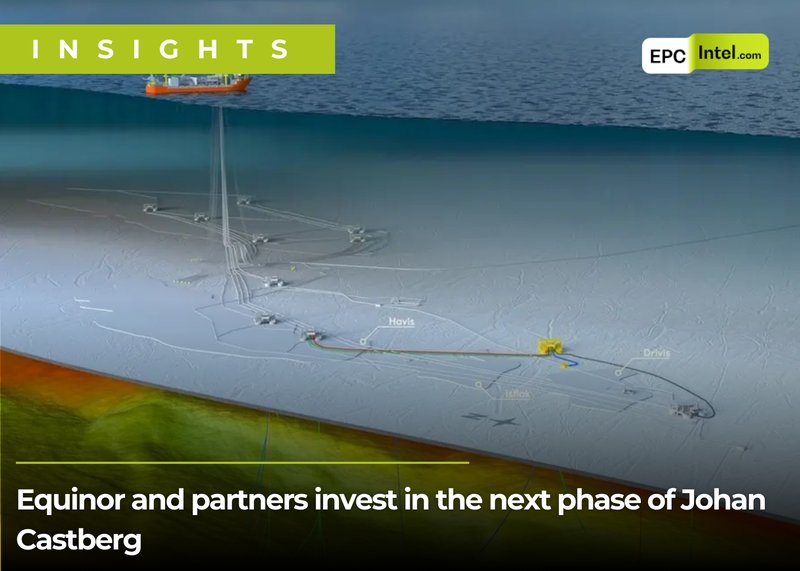
Eight months after Johan Castberg came on stream, the partners are already moving decisively into the next development phase. Equinor, together with Vår Energi and Petoro, has sanctioned the Isflak subsea tieback, committing just over NOK 4 billion in new investment in the Barents Sea. The decision underlines how quickly the Johan Castberg hub is being positioned as a long term production anchor in Norway’s northernmost offshore province.
Isflak is the first discovery to be tied back to the Johan Castberg FPSO, and it will test in practice the hub strategy that underpinned the original development. By leveraging existing infrastructure, standardised subsea solutions and streamlined regulatory processes, the partners are targeting fast cycle value creation in a region that historically suffered from long lead times and high unit costs.
Isflak as a blueprint for Barents Sea tiebacks
The Isflak development will be executed within the existing Johan Castberg licence. As a result, the partners have applied for an exemption from the requirement to submit a separate plan for development and operation. This alone removes several years from the typical project timeline and reinforces the role of Johan Castberg as a platform for incremental growth rather than a standalone project.
Production start-up is targeted for 2028. While Isflak on its own is modest in scale compared with legacy Norwegian Sea developments, its strategic importance is far larger. Equinor has made clear that maintaining production levels on the Norwegian continental shelf from 2020 to 2035 will depend heavily on new wells and subsea projects, as output from existing fields declines. Isflak is an early, tangible step in that direction.
Subsea intensity ramps up
Perhaps the most important signal in the announcement is the scale of subsea activity planned over the coming years. Equinor is planning around 75 subsea tiebacks, with Johan Castberg expected to absorb a meaningful share of that workload. For the supply chain, this points to a sustained cycle of awards rather than sporadic, one off developments.
In EPCIntel.com’s database, typical capital allocation for a NOK 4 billion class Barents Sea subsea tieback would broadly break down as follows. Subsea production systems, including trees, manifolds and controls, typically account for 30 percent to 35 percent of total spend, equivalent to NOK 1.2 billion to NOK 1.4 billion. Subsea installation, covering vessels, installation engineering and offshore execution, usually represents 20 percent to 25 percent, or roughly NOK 800 million to NOK 1 billion. Umbilicals, risers and flowlines often absorb another 15 percent to 20 percent, in the range of NOK 600 million to NOK 800 million. The remainder is split across drilling and completions, project management, engineering, modifications on the host facility and contingency.
EPC and supplier opportunities
For EPC contractors and key suppliers, Isflak reinforces several themes that have been building in the Norwegian offshore market. First, subsea standardisation is no longer just a cost saving concept, it is becoming a prerequisite for rapid sanctioning. Suppliers with pre qualified, configurable subsea architectures are best positioned as Equinor accelerates tieback activity.
Second, installation capacity in the Barents Sea will remain tight. Cold weather capability, winterisation and logistics expertise north of the Arctic Circle are still differentiators. Installation contractors with proven regional experience are likely to see repeat work as Johan Castberg evolves into a multi field hub.
Third, drilling and completions remain a significant value lever. Even in a tieback heavy strategy, new wells are essential to offset decline. This supports continued demand for subsea drilling services, well completions equipment and integrated well delivery models.
Strategic implications for the NCS
Isflak should be viewed less as a single NOK 4 billion project and more as a signal of intent. Equinor’s ambition to hold production flat through 2035 hinges on exactly this type of development, smaller, faster and capital efficient projects tied back to existing infrastructure. In that context, Johan Castberg plays a similar role in the Barents Sea to what Troll, Oseberg and Åsgard have long done further south.
The regulatory angle is also notable. By operating within the existing licence and seeking PDO exemption, the partners are effectively demonstrating how Norway’s mature regulatory framework can still support rapid project execution without compromising oversight or environmental standards.
A hub strategy coming into focus
As Isflak moves into execution, attention will quickly turn to what comes next around Johan Castberg. Additional discoveries, infill drilling and further subsea tiebacks are all logical candidates. With around 75 subsea tiebacks planned across Equinor’s portfolio in the coming years, the Barents Sea is no longer peripheral to Norway’s upstream future.
For the EPC and subsea supply chain, the message is clear. The next phase of Johan Castberg is not about one project, it is about building a repeatable development machine in the high north, and Isflak is only the beginning.