Chevron and its Gorgon JV partners have finally pulled the trigger on Gorgon Stage 3 in Western Australia, delivering a three billion Australian dollar subsea backfill that keeps one of the region’s most strategic LNG assets running deep into the 2030s. For EPC and supply chain players, this is the long awaited greenlight that pushes a sizeable basket of subsea and drilling work into the market at a time when WA activity is already tight.
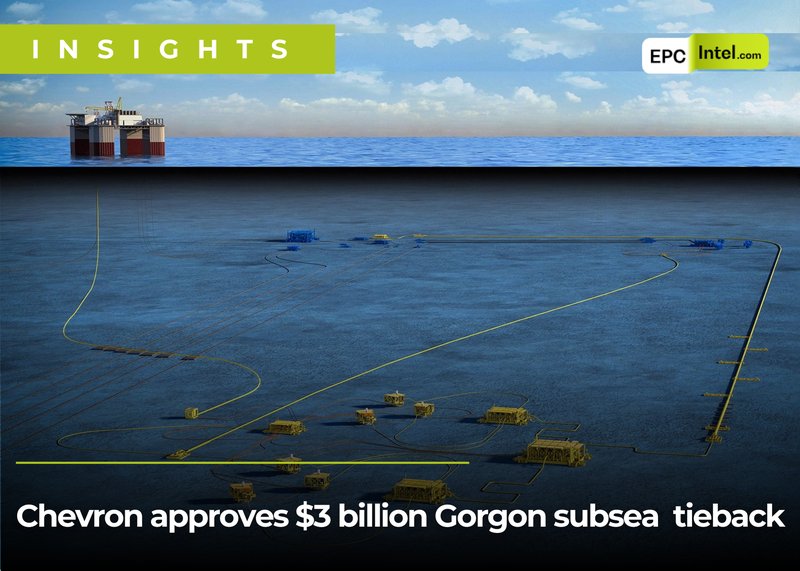
Stage 3 reconnects the development to its original masterplan, tapping the Geryon and Eurytion fields about one hundred kilometres northwest of Barrow Island. The project adds six new wells, three subsea manifolds and a thirty-five kilometre production flowline that will tie directly into Gorgon’s existing gas gathering system. Water depths of roughly thirteen hundred metres put this squarely in the deepwater category by Australian standards, ensuring a healthy scope for high specification subsea kit, installation vessels and drilling rigs.
Why it matters for LNG
Gorgon remains one of the largest and most dependable LNG producers in the Asia Pacific region. The asset can produce fifteen point six million tonnes per year of LNG and send three hundred terajoules per day into the WA domestic market. Backfilling is not optional. Without new gas, plateau would start slipping and long term contract commitments would become harder to meet.
Chevron Australia president Balaji Krishnamurthy put it bluntly. Gorgon is a world class energy asset that underpins energy security for WA and millions of customers in Asia. Stage 3 keeps that engine running. It shores up jobs, supply chains and government revenue while preserving the operational logic of the existing infrastructure, especially with the Jansz Io Compression Project progressing and the Stage 2 infill campaign already wrapped up.
EPC and supply chain impact
Three billion Australian dollars is substantial for a subsea backfill. Based on EPCIntel’s benchmarks for deepwater tiebacks of similar complexity, the capital split is likely to look roughly as follows.
• Subsea production systems, manifolds and controls: thirty to thirty five percent of total spend, roughly 900 to 1050 million Australian dollars.
• Flowlines, umbilicals and SURF installation: twenty five to thirty percent, about 750 to 900 million Australian dollars.
• Drilling and completions for six wells: twenty to twenty five percent, 600 to 750 million Australian dollars.
• Fabrication support, logistics and marine spreads: ten to fifteen percent, 300 to 450 million Australian dollars.
• Project management, engineering and integration: five to ten percent, 150 to 300 million Australian dollars.
These numbers will shift as contract awards crystallise, but they capture the order of magnitude suppliers should prepare for. The subsea hardware package will be the headline award and will draw strong interest from the usual deepwater leaders active in Australia. Installation is likely to tighten vessel availability across the region, especially given competing demand from Scarborough, Browse front end engineering activity and ongoing decommissioning programs.
Drilling is another heavy hitter. Six deepwater wells at thirteen hundred metres demands premium rigs, with long lead times and escalating day rates. Expect Chevron to lock in capacity early to maintain schedule discipline.
What comes next
Stage 3 is the first in a planned sequence of tiebacks that extend the life of the Gorgon and Jansz Io system. The advantage is clear. The infrastructure already exists. The gas is nearby. The economics are favourable compared with greenfield expansion. From the WA government’s point of view, this is exactly the kind of incremental development that keeps domestic supply stable while protecting export volumes.
For contractors, the next twelve months will set the tone. Major subsea awards, umbilical orders and installation contracts will move to the front of the queue. WA fabrication yards will see a lift in activity tied to manifold structures and subsea component integration. Offshore campaigns will ramp steadily as drilling and SURF spreads arrive in region.
Bottom line
Gorgon Stage 3 is not just another tieback. It is a strategic anchor that sustains one of the most consequential LNG hubs in the world. At three billion Australian dollars, it is a heavyweight opportunity for subsea suppliers, vessel operators, drilling contractors and engineering houses. More importantly, it reinforces the role of Western Australia as a long term, low risk LNG powerhouse in a market that is hungry for reliable supply.