Demand for low carbon fuels is accelerating across power generation, shipping and heavy industry, sectors where direct electrification remains technically or economically constrained. At the same time, offshore oil and gas developments continue to produce significant volumes of associated gas that struggle to find a route to market. Export pipelines are often undersized or non existent, LNG solutions are capital intensive, and flaring restrictions are tightening.
Blue ammonia sits at the intersection of these challenges. It provides a transportable hydrogen carrier with an established global logistics chain, while allowing natural gas resources to be monetised with materially lower emissions. According to the International Energy Agency, low carbon ammonia consumption must scale rapidly to meet decarbonisation targets in power and maritime transport.
Against this backdrop, BW Offshore has partnered with McDermott International to develop a floating blue ammonia FPSO concept that brings production, storage and export offshore.
An integrated offshore production concept
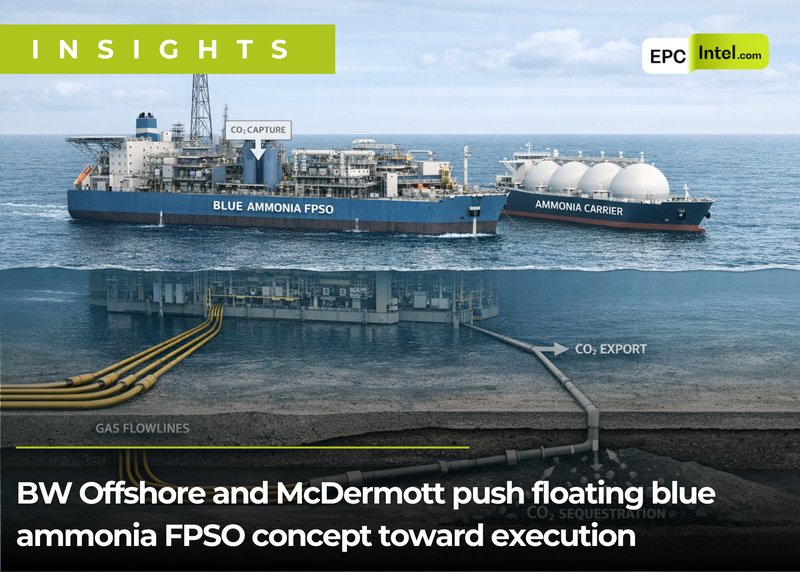
The proposed floating unit is designed to sit close to stranded or under utilised offshore gas resources, ideally within proximity of suitable CO₂ storage sites. Natural gas is delivered from nearby platforms via subsea flowlines and processed entirely on board.
The gas is first reformed to produce hydrogen, which is then converted to ammonia using a low carbon process incorporating carbon capture. The concept targets a gas intake capacity of up to 3 million cubic metres per day, translating into annual ammonia production in excess of one million tonnes.
Carbon capture is a central design feature. Up to 99 percent of CO₂ generated during hydrogen and ammonia production is captured, compressed and exported from the FPSO for geological sequestration or other approved use. This results in an estimated carbon intensity of roughly 0.5 tonnes of CO₂ per tonne of ammonia, placing the product within current definitions of low carbon hydrogen derivatives in key markets.
BW Offshore notes that further emissions reductions are possible through optional electrification or low carbon power solutions for on board utilities, potentially pushing lifecycle emissions close to zero where market premiums justify the additional investment.
Capital intensity and EPC scope
From an EPC perspective, the floating blue ammonia FPSO represents a substantial offshore processing project rather than a conventional production vessel. Based on EPCIntel.com benchmarks for comparable scale ammonia plants and large FPSO hulls, total capital expenditure for a one million tonne per year unit is likely to fall in the USD 3.5 to 5.0 billion range, depending on specification, power generation philosophy and CO₂ handling scope.
Typical capital allocation across major packages would broadly include:
• Hull, marine systems and ammonia storage, around 25 to 30 percent of total capex
• Ammonia synthesis, hydrogen reforming and process units, 30 to 35 percent
• Carbon capture, compression and CO₂ export systems, 15 to 20 percent
• Utilities, power generation and electrical systems, 10 to 15 percent
• Offshore installation, subsea tie ins and commissioning, 5 to 10 percent
For EPC contractors and suppliers, this opens opportunities across large scale modular process fabrication, cryogenic ammonia storage tanks, reformer and synthesis loop equipment, CO₂ compression trains, offshore power generation packages and subsea export systems.
Flexibility and simplified export
Locating ammonia production offshore removes many of the bottlenecks associated with onshore mega projects. Land access, permitting complexity, local opposition and extensive port infrastructure requirements are significantly reduced.
The FPSO hull incorporates refrigerated ammonia storage, enabling direct offloading to ammonia carriers. This eliminates the need for long distance pipelines, export terminals or dedicated ports, while allowing product to be shipped directly to end markets in Asia, Europe or the Americas.
This flexibility is particularly attractive for regions with mature offshore infrastructure but limited onshore industrial footprint, or where CO₂ storage is available offshore but distant from land based processing hubs.
Built on proven offshore delivery models
The partnership leverages BW Offshore’s track record in designing, financing and operating complex floating production units, combined with McDermott’s EPC, installation and technology integration capabilities across oil, gas and chemicals.
Importantly, the concept can be offered under leasing or build own operate structures familiar to upstream operators. This allows gas producers to monetise surplus gas and participate in low carbon fuel markets without carrying full upfront capital exposure on their balance sheets.
Part of a broader transition portfolio
The floating blue ammonia FPSO forms part of BW Offshore’s New Ventures portfolio, which targets offshore energy transition solutions that remain anchored in the company’s core competencies.
For EPC contractors, technology licensors and equipment suppliers, the concept signals a potential new class of offshore processing projects bridging upstream gas and downstream low carbon fuels. If even a handful of these units progress to FID, floating ammonia could quickly become a material new market alongside FPSOs, FLNG and offshore CO₂ infrastructure.
In a world where decarbonisation and energy security increasingly intersect, floating blue ammonia offers a pragmatic route to unlock stranded gas while building the foundations of a lower carbon fuels market.