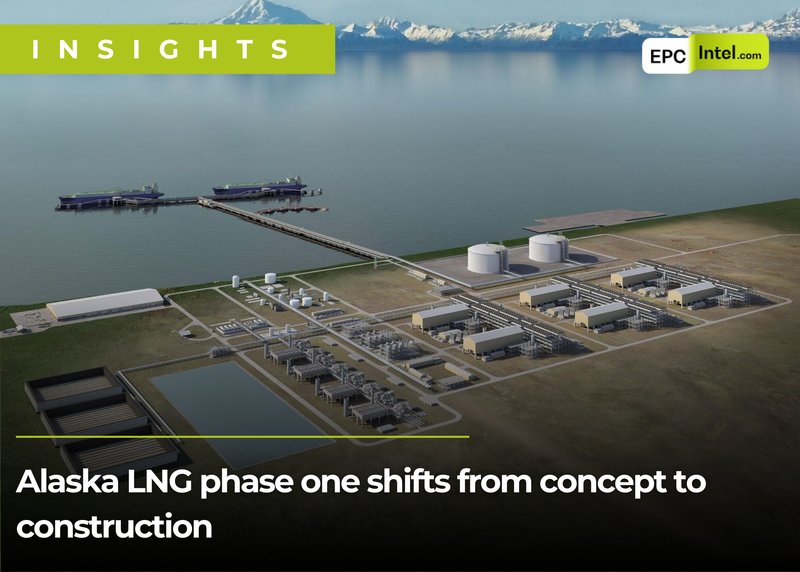
After more than a decade of false starts, Alaska LNG has taken a meaningful step out of the abstract. Glenfarne Group’s latest announcements around Phase One of the Alaska LNG Project signal a deliberate shift from long range ambition to early execution, anchored in construction strategy, supply chain alignment, and domestic demand rather than export led speculation.
At the center of the reset is Glenfarne Group, which became lead developer in March 2025 and now controls 75 percent of project vehicle 8 Star Alaska LLC alongside the State of Alaska. Glenfarne’s approach is to break Alaska LNG into two financially independent phases, reducing upfront capital exposure and allowing the project to advance on fundamentals rather than grand scale promises.
Phase One is a 739 mile, 42 inch natural gas pipeline running from the North Slope to Southcentral Alaska, potentially including the 63 mile Point Thomson lateral. The focus is domestic gas delivery, with mechanical completion targeted in 2028 and first gas in 2029. Phase Two, which adds a 20 million tonne per annum LNG export terminal, remains optionality rather than a gating item.
Worley lines up for EPCM role
Glenfarne has provisionally named Worley Limited as EPCM contractor for Phase One, following completion of sufficient engineering work to support a final investment decision by the end of 2025. While the award remains conditional, the selection of Worley is logical. The contractor has been embedded in Alaska LNG iterations for more than a decade and understands the regulatory, environmental, and logistical constraints better than most global peers.
From an EPCIntel.com database perspective, EPCM services for a pipeline of this scale typically represent around 5 to 7 percent of total installed cost. For Phase One, that implies a potential EPCM envelope in the range of USD 400 to 600 million spread across engineering, procurement oversight, construction management, and commissioning support.
Multi spread pipeline strategy takes shape
The most tangible progress comes from conditional construction awards for the pipeline itself. Glenfarne plans to execute Phase One through four simultaneous construction spreads, an approach designed to compress schedule and manage Alaska’s narrow construction windows.
The selected contractors include MasTec subsidiary Precision Pipeline, Quanta Services subsidiary Price Gregory, Michels Pipeline in joint bid with ASRC Energy Services’ Houston Contracting, a JV between Associated Pipe Line Contractors, Doyon Energy Services, and Cruz Construction, a JV between Barnard Pipeline and SICIM, and a JV between VINCI Construction’s Spiecapag and U.S. Pipeline.
Collectively, this group reflects a deliberate blend of Lower 48 scale, international megaproject experience, and Alaska specific execution capability. For EPCIntel benchmarks, large diameter, long haul pipelines in remote and arctic environments typically fall in a capital intensity range of USD 6 to 8 million per mile, inclusive of labor, logistics, camps, and right of way works. On that basis, Phase One pipeline construction alone points to USD 4.5 to 6.0 billion of EPC value, excluding EPCM, owner’s costs, and contingencies.
Line pipe supply locks in early
Pipe supply is another critical de risking step. Phase One requires approximately 700,000 metric tonnes of API 5L X70 pipe for the mainline plus 25,000 metric tonnes for the Point Thomson lateral. Glenfarne has secured preliminary agreements covering roughly two thirds of this requirement with Corinth Pipeworks and Europipe, with POSCO International supplying part of the steel feedstock.
At current market pricing, large diameter X70 line pipe typically ranges between USD 1,300 and 1,600 per tonne delivered, depending on coating and logistics. That places total line pipe spend for Phase One in the USD 950 million to 1.15 billion range, with around USD 650 to 750 million now conditionally locked in.
Gas supply and in state demand underpin economics
Unlike prior Alaska LNG concepts, Phase One is anchored by gas sales rather than export hopes. Glenfarne has executed gas sales precedent agreements with ExxonMobil, Hilcorp Alaska, and Pantheon Resources’ Great Bear subsidiary, with ConocoPhillips continuing discussions. These agreements define pricing frameworks, contract lengths, and volume commitments, providing the commercial backbone lenders typically look for.
On the demand side, a non binding letter of intent with ENSTAR Natural Gas Company for a 30 year supply contract and a separate LOI with Donlin Gold Mine for up to 50 MMcfd reinforce the domestic first logic. From an infrastructure investor perspective, this combination materially lowers volume risk and strengthens the case for phased financing.
A pragmatic reset for Alaska LNG
What distinguishes this moment is not scale, but sequencing. By aligning EPCM, construction spreads, pipe supply, gas sales, and in state offtake, Glenfarne has assembled enough moving parts to make Phase One credible on its own terms. For EPC contractors and suppliers, this creates a multi billion dollar pipeline centric opportunity with clearer timelines and fewer political unknowns than past Alaska LNG iterations.
Phase Two LNG exports remain a powerful upside, especially with 11 MTPA of preliminary buyer interest already outlined across Asia. But the message is clear. Alaska LNG no longer needs LNG to justify itself. If Phase One delivers, the rest can follow.