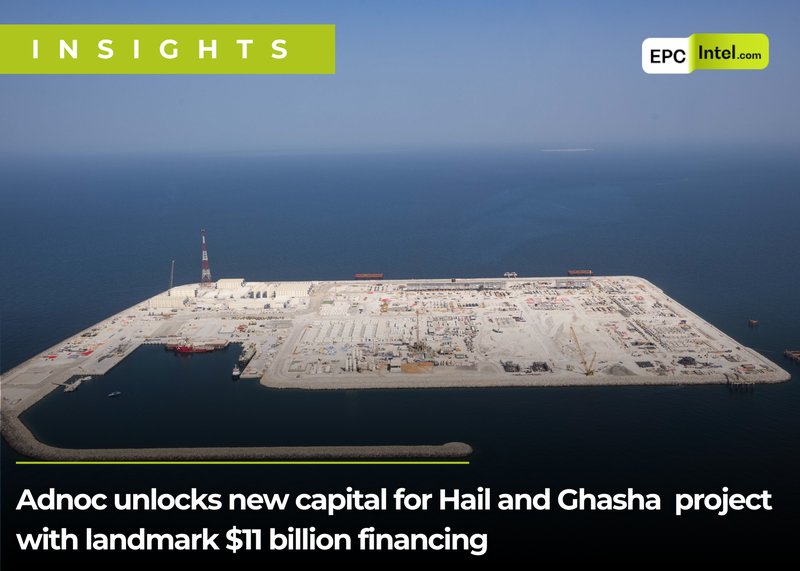
Adnoc has once again shown that it is not just building some of the world’s largest energy projects, it is also quietly rewriting the rulebook on how they are financed. The national oil company has secured up to $11 billion in non recourse structured financing linked to future midstream gas production from the Hail and Ghasha development, part of the wider Ghasha concession offshore Abu Dhabi. For EPC markets, this is not just a balance sheet story. It is a signal that one of the Middle East’s most complex offshore gas projects is financially de risked and structurally ready to absorb multi billion dollar contract awards.
The Ghasha concession is expected to produce 1.8 billion standard cubic feet per day of gas and is positioned as the world’s first offshore sour gas project targeting net zero operational emissions. That ambition alone places it in rare territory, combining ultra high H2S content reservoirs, large scale offshore facilities, and integrated carbon capture handling around 1.5 million tonnes per year of CO2. Financing of this scale and structure effectively locks in long term momentum for EPC and supply chain players across offshore, onshore, and midstream segments.
Why the financing matters for project delivery
The $11 billion transaction monetizes future midstream gas production and ring fences processing facilities and operations. In practical terms, this creates a clean financial perimeter around the midstream scope, allowing ADNOC and its partners Eni and PTTEP to raise low cost capital while retaining operational control. More than 20 global and regional financial institutions participated, underscoring that lenders see construction and execution risk as manageable.
For EPC contractors, this matters because financing certainty tends to precede contract acceleration. ADNOC has a long history of moving rapidly from financial close to major awards, particularly when non recourse structures are in place. This transaction follows ADNOC’s earlier $10.1 billion gas pipeline deal and $4.9 billion oil pipeline partnership, both of which translated directly into sustained EPC and supplier workloads.
Capital spend breakdown and EPC opportunities
Based on EPCIntel.com benchmarking of comparable ADNOC offshore gas and sour gas developments, total capital expenditure for the wider Hail and Ghasha development is expected to sit in the high tens of billions of dollars over its life cycle. The structured financing targets the midstream slice, but the knock on effect is broader.
Offshore EPC is likely to account for roughly 35 to 40 percent of total capital spend. This includes fixed platforms, jackets, topsides, offshore compression, and wellhead facilities designed for extreme sour service. Typical package values here range from $1.5 billion to $3 billion per major offshore EPC package, depending on scope bundling. Contractors with deep ADNOC experience such as McDermott, Saipem, NMDC Energy, and Technip Energies are natural contenders, with fabrication yards in the UAE playing a central role.
Subsea and offshore installation typically represents around 10 to 15 percent of capital spend. This covers subsea pipelines, umbilicals, risers, and hook up campaigns. Individual contracts in this segment often fall in the $500 million to $1.2 billion range, with Subsea7, Saipem, and regional installation specialists well positioned.
Onshore gas processing and carbon capture infrastructure is another major pillar, estimated at 30 to 35 percent of total capex. Sour gas treatment, sulfur recovery units, CO2 compression, and export facilities are capital intensive and technologically complex. EPC package values here can easily exceed $2 billion per processing train, opening opportunities for Technip Energies, Samsung E&A, JGC, and Petrofac, alongside licensors and specialist equipment suppliers.
Utilities, power, and BOOT style infrastructure accounts for the remaining 10 to 15 percent. ADNOC has already demonstrated a preference for BOOT models for power and water, as seen in its $3.8 billion offshore decarbonization project and $2.2 billion water supply scheme. Similar structures could emerge around power generation, electrification, and CO2 handling at Ghasha, creating long term revenue streams for developers and EPC partners.
A replicable model with wider implications
What makes this financing particularly notable is its replicability. By anchoring lender confidence to ADNOC’s role as upstream developer and long term offtaker, the structure creates bankable cash flows from assets that are still under development. This is highly attractive for large greenfield projects that might otherwise struggle with capital intensity and long payback periods.
For the EPC market, the message is clear. ADNOC is not slowing down, and it is not constrained by traditional funding models. Hail and Ghasha is now firmly positioned as a multi year engine of offshore and onshore contract awards, with financing risk largely neutralized.
As ADNOC continues to blend innovative financing with aggressive project execution, contractors and suppliers would be wise to treat this transaction as more than a headline. It is a green light for one of the Middle East’s most strategically important gas developments, and a reminder that when ADNOC secures the money, the projects tend to follow at scale.