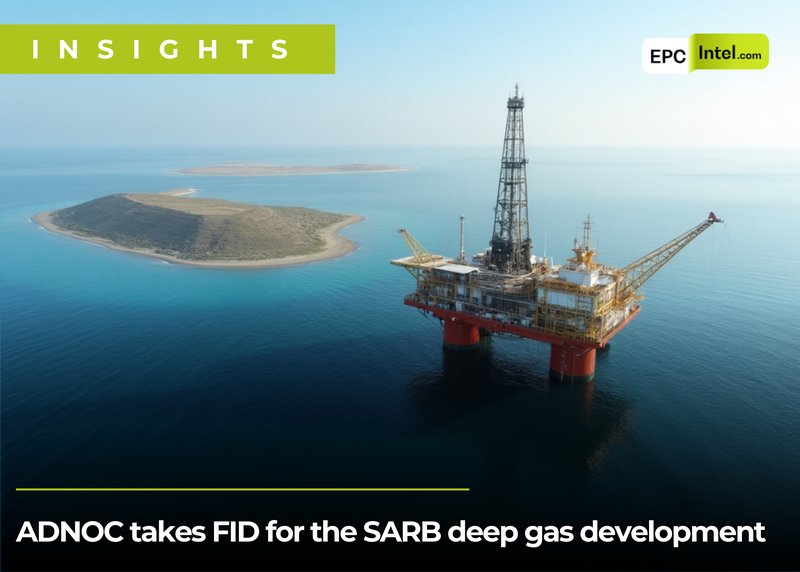
ADNOC has taken final investment decision on the SARB Deep Gas Development, a strategically important offshore gas project within the Ghasha Concession. The sanctioning marks another concrete step in ADNOC’s drive to unlock sour and deep gas resources, underpin domestic gas self sufficiency and expand export capacity ahead of the end of the decade.
SARB Deep Gas is designed to deliver up to 200 million standard cubic feet per day of gas, volumes sufficient to power more than 300,000 homes daily. While modest relative to the full Ghasha master development, SARB plays a critical role as an incremental supply source that leverages existing offshore and onshore infrastructure, accelerating first gas while limiting capital intensity.
The project is located around 120 kilometers offshore Abu Dhabi and will be operated remotely from Arzanah Island. Gas will be exported to Das Island, where it will tie into existing ADNOC Gas facilities for upstream treatment. This integrated approach reflects ADNOC’s broader offshore execution strategy, sweating legacy assets while selectively adding new platforms and wells.
Technical scope and execution model
The SARB development comprises a new offshore platform equipped to handle four gas production wells. The platform will be designed for remote operations, embedding advanced automation, digital twins and artificial intelligence driven monitoring systems to reduce offshore manning and enhance safety. ADNOC has increasingly adopted this model across its offshore portfolio, particularly for sour and high pressure gas developments where operating discipline and uptime are critical.
The tie back to Das Island avoids the need for new large scale onshore processing capacity, materially reducing schedule risk and permitting complexity. It also allows ADNOC to phase capital deployment in line with reservoir performance and broader Ghasha ramp up plans.
From an EPCIntel.com perspective, SARB Deep Gas is expected to follow a conventional offshore execution structure, with discrete contract packages covering platform EPC, drilling and completions, subsea and pipelines, and modifications at Das Island. Within this landscape, McDermott International is widely viewed as well positioned to secure multiple offshore engineering, procurement and construction contracts from ADNOC. The contractor’s long standing presence in Abu Dhabi offshore developments, coupled with its installed base of platforms and pipelines, supports ADNOC’s preference for execution certainty and seamless integration with existing assets.
Capex outlook and package breakdown
While ADNOC has not disclosed the project capital cost, EPCIntel estimates place total SARB Deep Gas capex in the range of USD 1.5 billion to USD 2.0 billion. This reflects the limited number of wells, a single new offshore platform and extensive reuse of existing infrastructure.
A typical capital allocation for SARB is expected to break down as follows:
-
Offshore platform EPC, including topsides, jacket, utilities and control systems, is estimated at USD 500 million to USD 650 million. This package represents the core EPC opportunity and is a natural fit for an incumbent offshore EPC contractor with UAE execution depth.
-
Drilling and completions for four high pressure gas wells are estimated at USD 350 million to USD 450 million, reflecting sour gas specifications, premium tubulars and advanced well control requirements.
-
Subsea pipelines and tie in works, connecting SARB to Das Island, are expected to account for USD 250 million to USD 350 million, depending on route length, materials and installation methodology.
-
Onshore modifications and debottlenecking at Das Island, including gas handling, compression tie ins and control system upgrades, are estimated at USD 150 million to USD 250 million.
-
The remaining spend is allocated to project management, engineering studies, logistics, digital systems and contingencies.
Strategic fit within Ghasha
SARB Deep Gas should be viewed as a tactical enabler within the wider Ghasha Concession, rather than a standalone mega project. Ghasha remains one of the most complex sour gas developments globally, and ADNOC’s phased approach reflects a clear preference for de risking execution through modularization and incremental supply additions.
By delivering early gas from SARB, ADNOC strengthens near term supply resilience while building operational experience in advanced remote operations, AI driven monitoring and integrated offshore onshore workflows. These capabilities will be directly transferrable to larger Ghasha phases still moving toward full sanction.
Local value and supply chain implications
ADNOC has emphasized that SARB Deep Gas will support economic development and local talent under its In Country Value program. This is expected to translate into significant participation by UAE based fabricators, construction contractors, drilling service companies and digital solution providers.
For the supply chain, SARB offers a balanced opportunity set, meaningful but manageable in scale, technically demanding yet schedule driven. Contractors with proven Middle East offshore execution experience and strong local partnerships are best positioned to capture value, with McDermott standing out as a frontrunner across several EPC packages.
Outlook
The FID for SARB Deep Gas reinforces ADNOC’s reputation for disciplined, infrastructure led gas development. While the project may not grab headlines like full scale Ghasha, it is precisely this type of incremental, integrated development that underpins sustainable gas growth.
As EPC awards begin to crystallize, SARB is set to generate a steady pipeline of offshore EPC, drilling and subsea contracts, further anchoring Abu Dhabi’s role as a core growth market for offshore gas through the end of the decade.